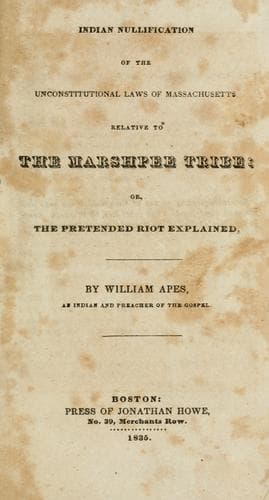
Indian Nullification of the Unconstitutional Laws of Massachusetts Relative to the Marshpee Tribe: Or, the Pretended Riot ExplainedApess, William
History
Indian Nullification of the Unconstitutional Laws of Massachusetts Relative to the Marshpee Tribe: Or, the Pretended Riot Explained
Apess, William
Indians of North America -- Legal status, laws, etc.; Mashpee Indians -- Land tenure; Mashpee Indians -- Legal status, laws, etc.
majority of _whites_. Mr. Fish himself testified before the Committee,
that the church at Marshpee, in 1811, consisted of sixteen whites
and but five colored persons. The church members were a majority of
whites, so that even had the church voted to settle Mr. Fish, it would
have been a vote of white men having no interest in the premises, and
not of Indian Proprietors. Mr. Fish admits that the church passed no
vote. It was asserted by one of the old Overseers, Mr. Hawley, that
five Indians called on him, after Mr. Fish had preached there, and
personally expressed a wish to have him stay with them, but there was
no official act, and no vote of the church or society, and no assent
of the Proprietors of Marshpee in any form.
Who were the Congregational church, and who the society in Marshpee,
in 1811? A regularly gathered Congregational church, is composed
of several persons associated by covenant or agreement of church
fellowship, (9th Mass. 277.) and a church cannot exist for any legal
purposes, except as connected with a congregation or some regularly
constituted religious society. (16 Mass. 488.) Where there are no
special powers given to the church by the Legislature, the church
cannot contract with or settle a minister, but that power resides
wholly in the parish, of which the members of the church, who _are
inhabitants_, are a part. (9 Mass. Reports, 277. Burr vs. First Parish
in Sandwich.)
We have seen that there was no legal parish in Marshpee, in 1811, and
therefore the Congregational church, if there were such then, had no
power to settle Mr. Fish, even had they done so, which they did not.
A parish may elect a public teacher, and contract to support him,
without the consent of the church, if he be ordained by a council
invited by the parish; but in Mr. Fish's case, he was ordained by the
request and under the direction of the President and Corporation of
Harvard College, the Trustees of the Williams fund, with the assent of
the Overseers. There is then no ground whatever for assuming that
Mr. Fish ever was settled legally over a Congregational parish in
Marshpee, so as to establish him a sole corporation, to hold the lands
belonging to the Proprietors of Marshpee, under the dedication deed of
1783. If that deed and the subsequent act of 1809, conveyed any thing,
the conveyance was for the use of the inhabitants as a parsonage,
there being no parish in Marshpee, distinct from the Plantation. In
such case, it would be held to be a grant to Marshpee, (that is
the town,) for the use of its ministers, (14 Mass. 333.) The grant,
therefore, could it be regarded as such, was to the whole Proprietors
of Marshpee, and they must first settle a minister before he could
claim the use of the grant as a minister of the parish.
Public-domain text, read in full here on John Shaqi.
Reviews
Reviews
No reviews yet
Be the first to share your thoughts on this work.
Elsewhere in the archive
Join the Discussion
Join the discussion
Sign in to leave a comment or review.
Sign InorCreate an account