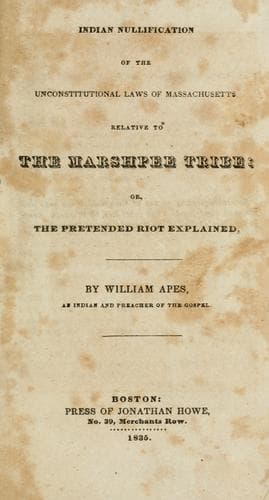
Indian Nullification of the Unconstitutional Laws of Massachusetts Relative to the Marshpee Tribe: Or, the Pretended Riot ExplainedApess, William
History
Indian Nullification of the Unconstitutional Laws of Massachusetts Relative to the Marshpee Tribe: Or, the Pretended Riot Explained
Apess, William
Indians of North America -- Legal status, laws, etc.; Mashpee Indians -- Land tenure; Mashpee Indians -- Legal status, laws, etc.
Neither has Mr. Fish, even if he had been legally settled, any just
right, under the deed of 1783, to take the whole parsonage, because
that deed states the principal object of the sequestration of the land
to be, for the important purpose of promoting the gospel in Marshpee,
and merely referred to the only worship then known there, which was
Congregational. When Mr. Fish went there in 1811, there was a Baptist
church, and they objected to his taking possession of the parsonage.
There is a case in point in the 13th Mass. Rep. 190, which decides,
that where the original Proprietors of a township appropriated a lot
of land for a parsonage, and at the same time voted that they would
endeavor that a Congregational minister should be settled in the
township, such vote ought not to be construed to limit the benefit of
the parsonage to a minister of the Congregational order, and that if
the inhabitants of the parish should become Christians of any other
Protestant sect, they would be entitled to the land, and that a
Congregational society, incorporated as a full parish would have no
right to the parsonage. Neither can a parish convey a parsonage to a
minister to be held by him in his personal right. By this decision,
the Baptist or Methodist church in Marshpee have as good claim to the
parsonage as Mr. Fish has.
The dedication, or whatever it may be called, of Marshpee parsonage,
was made by Lot Nye, &c. in 1783, and confirmed in 1809, by the
General Court. Mr. Fish did not become a minister in Marshpee, until
1811. Whoever settled him there, for the Indians did not, made no
stipulation as to the income of the parsonage, which could bind the
Plantation. The society only, could make such stipulation, and they
did not act in the premises. The Overseers could make no stipulation
either to bind the parish or the proprietors, because their power only
extended to giving a lease of land not exceeding two years. In the
case of Thompson vs. the Catholic-Congregational Society in
Rehoboth, (5th Pickering, 469,) it was settled that where there was
a ministerial fund in a parish, and the society settled a minister
stipulating to pay him a salary, without taking any notice of the
income of the fund, he must be considered as accepting the salary as
a full compensation, and the society are entitled to the fund. Harvard
College settled Mr. Fish in Marshpee, and agreed to pay him about five
hundred dollars, or two-thirds the proceeds of the Williams fund. The
society to which Mr. Fish was sent to preach, took no notice of the
parsonage, nor did the Proprietors of Marshpee, hence Mr. Fish cannot
hold the proceeds of the parsonage by right of succession, or by
stipulation, either from the society or the Marshpee Proprietors, and
therefore the Proprietors of Marshpee are entitled to the parsonage.
Public-domain text, read in full here on John Shaqi.
Reviews
Reviews
No reviews yet
Be the first to share your thoughts on this work.
Elsewhere in the archive
Join the Discussion
Join the discussion
Sign in to leave a comment or review.
Sign InorCreate an account