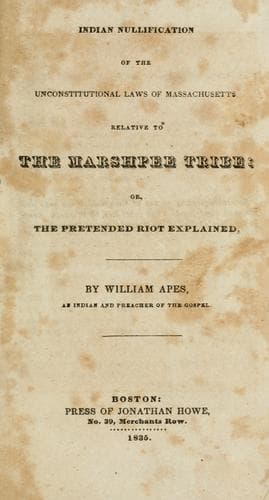
Indian Nullification of the Unconstitutional Laws of Massachusetts Relative to the Marshpee Tribe: Or, the Pretended Riot ExplainedApess, William
History
Indian Nullification of the Unconstitutional Laws of Massachusetts Relative to the Marshpee Tribe: Or, the Pretended Riot Explained
Apess, William
Indians of North America -- Legal status, laws, etc.; Mashpee Indians -- Land tenure; Mashpee Indians -- Legal status, laws, etc.
I have thus given my views of the law and the facts, touching the
parsonage in Marshpee, in order that the Indians and their Selectmen
who have desired legal advice on the subject, may fully understand
their rights. I am confident they will never attempt to obtain those
rights, except in a legal and peaceable way. The Courts at Barnstable,
it is said, are closed to them, in the way pointed out by the law, the
District Attorney refusing to prosecute the men who cut wood on the
parsonage. I invite the attention of that acute and learned officer,
Charles H. Warren, Esq. to the points made in this opinion, well
assured that if it can be refuted by any professional gentleman, it
can be done by him. If he cannot do so, I hope he will permit the
title of the parsonage to be brought before the Court, under an
indictment for cutting wood contrary to the act of 1834. I regret the
necessity of presenting arguments to dispossess Mr. Fish of what he
doubtless supposes be lawfully holds; but I am looking for the rights
and the property of the Indians, and am not at liberty to consult
personal feelings, that would certainly induce me to favor the Rev.
Mr. Fish, as soon as any man in his situation. I think it as important
to him as to the Indians, that the title to the parsonage should be
settled, for there will be feuds, and divisions, and strifes, as long
as that property remains as it now is, wrongfully taken and withheld
from the Indians, to support an "ESTABLISHED CHURCH," in Marshpee.
With this view I have proposed to Mr. Fish, in behalf of the Indians,
to make up an amicable suit, before the Supreme Court, and obtain
their opinion, and the parties be governed by it. The Indians are
ready to submit it to such an arbitration. Mr. Fish declines. The
only other remedy is an injunction in chancery, to stop the cutting of
wood. The Indians are not well able to bear the expense, at present,
or this course would be taken to recover their property. Until some
legal decision is had, Mr. Fish cannot but see, from an examination of
the legal grounds set forth herein, that there are strong reasons
for regarding him as holding in his possession that which rightfully
belongs to another. The public will not be satisfied, until the rights
of the Indians are fully secured. I have always been desirous that Mr.
Fish should not be disturbed in his house lot, and for my own part,
it would give me pleasure, should the Indians, immediately, on getting
legal possession of their own parsonage, unanimously invite him
to settle over them. But so long as he withholds from them their
property, it cannot be expected that they should receive him as their
spiritual teacher. It is in direct violation of the Constitution and
of religious freedom.
BENJAMIN F. HALLETT,
_Counsel for the Marshpee Indians.
Boston, May, 20, 1835_.
The Selectmen of Marshpee District, are at liberty to make such use of
the foregoing, as they think proper.
Public-domain text, read in full here on John Shaqi.
Reviews
Reviews
No reviews yet
Be the first to share your thoughts on this work.
Elsewhere in the archive
Join the Discussion
Join the discussion
Sign in to leave a comment or review.
Sign InorCreate an account