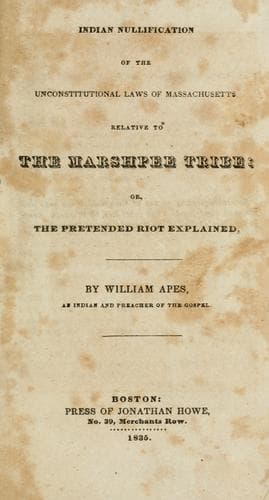
Indian Nullification of the Unconstitutional Laws of Massachusetts Relative to the Marshpee Tribe: Or, the Pretended Riot ExplainedApess, William
History
Indian Nullification of the Unconstitutional Laws of Massachusetts Relative to the Marshpee Tribe: Or, the Pretended Riot Explained
Apess, William
Indians of North America -- Legal status, laws, etc.; Mashpee Indians -- Land tenure; Mashpee Indians -- Legal status, laws, etc.
_Hon. Charles Marston_, (one of the Overseers,) testified that
Mr. Fish had a Sunday School, principally composed of white
children. He did not recollect ever seeing more than eight
colored children in it. There were more whites. The Overseers
paid the school mistress seven and sixpence a week, and she
board herself. To an Indian, who kept school in winter, were
paid twelve and nineteen dollars a month. The whites who
attend Mr. Fish's meeting, never pay any thing to him or the
church. When the tax was required in parishes, many whites got
rid of their tax by attending Mr. Fish's meeting. There was
always twice as many whites as blacks in the society. Last
summer, (1833,) he counted eighteen colored persons, and
twice that number of whites. Mr. Dwight, one of the Committee,
asked, if so many whites being there, did not tend to
discourage the Indians from being interested in the meeting?
Mr. Marston thought it might.
_Deacon Isaac Coombs_, who had been twenty years a deacon in
Mr. Fish's church, changed his sentiments, and was baptized
by immersion. He testified before the Committee of the
Legislature, that when he told Mr. Fish he had been baptized
again, Mr. Fish said, "that was rank poison, and that he
should expect some dreadful judgment would befal me." Deacon
Coombs, who is sixty years old, testified also, that the
Meeting-house was built for the use of the Indians. No one
could remember when it was built. There was but one colored
male church member, when Mr. Fish came to Marshpee, in
1811. He further stated to the Committee that his family got
discouraged going to Mr. Fish's meeting, from the preference
he gave to the whites. He did not come to see his family, and
lost his influence by taking part with the guardians against
the Indians. There was a difficulty in Mr. Fish's meeting
about the singing. The colored people were put back, and the
whites took the lead. Mr. Fish has 50 or 60 acres of pasture,
East of the river, besides the parsonage.
* * * * *
Public-domain text, read in full here on John Shaqi.
Reviews
Reviews
No reviews yet
Be the first to share your thoughts on this work.
Elsewhere in the archive
Join the Discussion
Join the discussion
Sign in to leave a comment or review.
Sign InorCreate an account