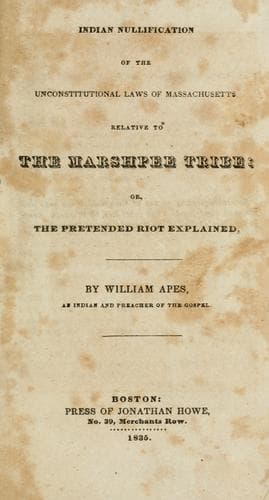
Indian Nullification of the Unconstitutional Laws of Massachusetts Relative to the Marshpee Tribe: Or, the Pretended Riot ExplainedApess, William
History
Indian Nullification of the Unconstitutional Laws of Massachusetts Relative to the Marshpee Tribe: Or, the Pretended Riot Explained
Apess, William
Indians of North America -- Legal status, laws, etc.; Mashpee Indians -- Land tenure; Mashpee Indians -- Legal status, laws, etc.
However, several weeks previous to this the Governor and Council had
been apprised of what was going forward, and had authorised one of the
Council to visit the tribe, in order to hold counsel, and if possible,
restore peace among them. But the first of July arrived before he
came, and we did even as we had pledged ourselves to do, having in
view no other end than the assertion and resumption of our rights. Two
of the whites, indeed, proved themselves enemies to the Indians, by
holding themselves in readiness to break up the new government, and
daring them to carry it into effect. They were brothers, and one of
them has since gone to his reward. Their name was Sampson. They came,
in defiance of our resolutions, to take away our wood, in carts. As I
was walking in the woods, I discovered them in the act of removing
our property, and called to him who was the owner of the teams to come
near me. He complied, and appeared much agitated as he approached.
I mildly stated to him the views and intentions of the tribe, saying
that it was not their design to wrong or harm any man in the least,
and that we wished them to desist till we should have had a settlement
with the Overseers, after which every thing should be placed upon a
proper footing. I begged them to desist, for the sake of peace; but it
was to no purpose. They said that they knew what they were about, and
were resolved to load their teams. I answered, that the men who owned
the wood were resolved to carry their resolutions into force; and
asked if they had not seen the notification we had posted up. One of
them replied that he had seen, but had not taken much notice of it. I
again told them that the owners of the wood were at hand, and by the
time one of the teams was laden, the Indians came up. I then asked
William Sampson, who was a member of the missionary's church, if
he would, even then, unload his team and wait till things were
more quiet; to which he replied that he would not. I then, having
previously cautioned the Indians to do no bodily injury to any man,
unless in their own defence, but to stand for their rights, and
nothing else, desired them to unload the teams, which they did very
promptly. One of the Sampsons, who was a justice of the peace, forbade
them, and threatened to prosecute them for thus protecting their own
property, which had no other effect than to incite them to work more
diligently. When they had done, I told the justice, that he had,
perhaps, better encourage others to carry away what did not belong
to them, and desired the teamsters to depart. They said they would,
seeing that it was useless to attempt to load the carts. Throughout
this transaction the Indians uttered neither a threat nor an unkind
word, but the white men used very bitter language at being thus, for
the first time, hindered from taking, away what had always been as a
lawful spoil to them hitherto.
Public-domain text, read in full here on John Shaqi.
Reviews
Reviews
No reviews yet
Be the first to share your thoughts on this work.
Join the Discussion
Join the discussion
Sign in to leave a comment or review.
Sign InorCreate an account