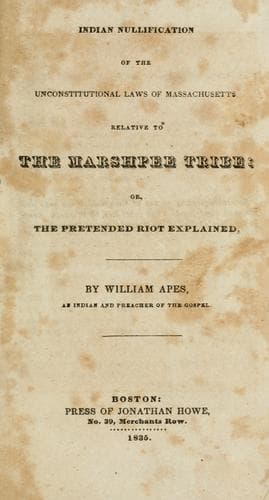
Indian Nullification of the Unconstitutional Laws of Massachusetts Relative to the Marshpee Tribe: Or, the Pretended Riot ExplainedApess, William
History
Indian Nullification of the Unconstitutional Laws of Massachusetts Relative to the Marshpee Tribe: Or, the Pretended Riot Explained
Apess, William
Indians of North America -- Legal status, laws, etc.; Mashpee Indians -- Land tenure; Mashpee Indians -- Legal status, laws, etc.
For a long time the Indians had been disaffected, but no one was
energetic enough among them to combine them in taking measures for
their rights. Every time they had petitioned the Legislature, the
laws, by the management of the interested whites, had been made more
severe against them. DANIEL AMOS, I believe, was the first one among
them, who conceived the plan of freeing his tribe from slavery.
WILLIAM APES, an Indian preacher, of the Pequod tribe, regularly
ordained as a minister, came among these Indians, to preach. They
invited him to assist them in getting their liberty. He had the talent
they most stood in need of. He accordingly went forward, and the
Indians declared that no man should take their wood off their
plantation. APES and a number of other Indians quietly unloaded a load
of wood, which a Mr. SAMPSON was carting off. For this, he and some
others were indicted for a riot, upon grounds extremely doubtful in
law, to say the least. Every person on the jury, who said he thought
the Indians ought to have their liberty, was set aside. The three
Indians were convicted, and APES was imprisoned thirty days.
It was in this stage of the business, after the conviction, that I
became the counsel of the Indians, and carried their claims to the
Legislature, where they finally prevailed.
The persons concerned in the riot, as it was called, and imprisoned
for it, I think were as justifiable in what they did, as our fathers
were, who threw the tea overboard; and to the energetic movements of
WILLIAM APES, DANIEL AMOS and others, it was owing that an impression
was made on the Legislature, which induced them to do partial justice
toward this long oppressed race. The imprisonment of those men, in
such a cause, I consider an honour to them, and no disgrace; no more
than the confinement of our fathers, in the Jersey prison-ship.
BENJAMIN F. HALLETT,
_Counsel for the Marshpee Indian_.
INTRODUCTION.
* * * * *
Public-domain text, read in full here on John Shaqi.
Reviews
Reviews
No reviews yet
Be the first to share your thoughts on this work.
Join the Discussion
Join the discussion
Sign in to leave a comment or review.
Sign InorCreate an account