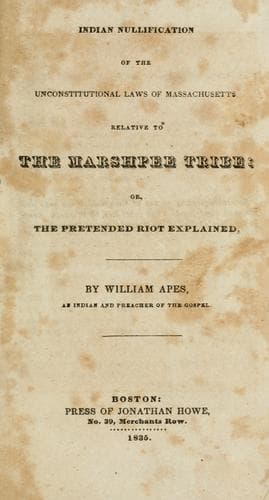
Indian Nullification of the Unconstitutional Laws of Massachusetts Relative to the Marshpee Tribe: Or, the Pretended Riot ExplainedApess, William
History
Indian Nullification of the Unconstitutional Laws of Massachusetts Relative to the Marshpee Tribe: Or, the Pretended Riot Explained
Apess, William
Indians of North America -- Legal status, laws, etc.; Mashpee Indians -- Land tenure; Mashpee Indians -- Legal status, laws, etc.
it was to see that its red children were not abused in this way. We
greatly fear that our white fathers did not much care about their
colored children in Marshpee. At any rate, it may be some satisfaction
to the philanthropists in the country to know how liberal they have
been to their poor dependants.
To begin--the Indians owe nothing to the Commonwealth of
Massachusetts, or to the inhabitants of New England generally, for
religious instruction, excepting a single appropriation of
four hundred dollars, made in 1816 or 1818, for repairing their
Meeting-house. Four hundred dollars more were appropriated in 1831,
for the purposes of erecting two school houses; but not one cent for a
teacher.[6]
The way the Marshpees have supported a school hitherto, has been this.
Some of them have lived abroad among the whites, and have learned to
read and write, with perhaps some small smattering of arithmetic.
On returning to the tribe, they have taught others what they knew
themselves; receiving pay from those who had the means, and teaching
the rest gratuitously. At the same time they have been compelled to
support a preacher whom they did not wish to hear, and to pay, in one
way or other, to the amount of four hundred dollars _per annum_ to
white officers, for doing them injury and not good. Thus then, in one
hundred and forty years they have paid fifty-six thousand dollars to
the whites, out of their own funds, in obedience to the laws of the
Commonwealth. In return, the whites have given them one thousand in
labor and money. Truly the Commonwealth must make haste, or it will
hardly be able to pay us the interest of our money. The principal we
never expect to get.
Thus, though it is manifest that we have cost the government
absolutely much less than nothing, we have been called State
paupers, and as such treated. Those are strange paupers who maintain
themselves, and pay large sums to others into the bargain. Heigho! it
is a fine thing to be an Indian. One might almost as well be a slave.
To return to the proceedings of the court at Cotuet: When supper time
was past, the Cotueter's were anxious to draw something out of me,
by questioning. They said they knew more about the matter than I did;
that I had gotten myself into difficulty, and that Mr. Fish was a good
man, and had gained twenty members over to his church in twenty-five
years. They might have added that these were infants, who became
members merely by undergoing the rite of baptism. Perhaps they were
very good members, when they grew up--perhaps not.
Public-domain text, read in full here on John Shaqi.
Reviews
Reviews
No reviews yet
Be the first to share your thoughts on this work.
Join the Discussion
Join the discussion
Sign in to leave a comment or review.
Sign InorCreate an account