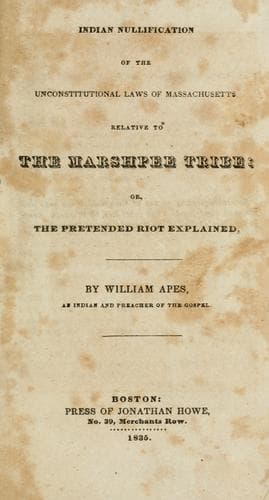
Indian Nullification of the Unconstitutional Laws of Massachusetts Relative to the Marshpee Tribe: Or, the Pretended Riot Explained — John Shaqi
Indian Nullification of the Unconstitutional Laws of Massachusetts Relative to the Marshpee Tribe: Or, the Pretended Riot ExplainedApess, William
History
Indian Nullification of the Unconstitutional Laws of Massachusetts Relative to the Marshpee Tribe: Or, the Pretended Riot Explained
Apess, William
Indians of North America -- Legal status, laws, etc.; Mashpee Indians -- Land tenure; Mashpee Indians -- Legal status, laws, etc.
We learn from South Sandwich that the Indians, constituting
the Marshpee tribe, intend to petition at the sitting of the
next Legislature, for a redress of grievances, and a revision
of the code of laws by which they are governed. The recent
revolt among them, and the measures adopted to make known
their situation and treatment, by themselves, and by those who
have avowed their friendship toward them, (its validity time
will determine,) gave rise to considerable excitement. An
inquiry into the state of affairs was instituted, which
terminated, as far as we have been able to learn, to the
satisfaction of those employed in the investigation, that
some of the evils under which they are labouring are real,
and rendered so by the laws of the Commonwealth, but many
imaginary. We do not doubt that the state of society among
them is low and degraded, comparatively speaking, but what
contributes to keep them in this situation we are unable to
say, unless it be, that the plantation has been a resort of
the vagrant, the indolent, and those whom refined society
would not allow among them. If this is the case, and we
believe it has been, something should be done, either among
the Indians, or by the Legislature, to remedy the evil.
We have understood also, that certain individuals, located
contiguous to the plantation, retail ardent spirits to them
in quantities as large as they are able to pay for. If this be
the fact, such men should be ferreted out, and in justice to
the Indians, to the community about them, and to the laws of
the land, they should be made to suffer, by being exhibited to
public derision, and by the penalty of the act prohibiting
the retail of spirits. If they have not the power, and no one
feels willing to go forward in shutting up these poisonous
springs, give them the power, and if they do not exercise it,
let them suffer.
Mr. Apes is among them, and attended the "Four Days Meeting,"
held during the present month, which we are told was managed
with good order and regularity.
The writer here says that the Indians are vile and degraded; and
admits that they can be improved. He gives no explanation of the
causes of their degradation. If the reader will take the trouble to
examine the laws regarding the Marshpees, he will see those causes of
the inevitable and melancholy effect, and, I am sure, will come to
the conclusion that any people living under them must necessarily be
degraded. The Journal, however, does us the small justice to admit,
that we are not so degraded but that we can hold a meeting of four
days duration, with propriety and moderation. What, then, might we not
do, were proper pains taken to educate us.
The next two extracts are from the Boston Advocate of September 10 and
11, 1833.
THE MARSHPEE INDIANS.
Public-domain text, read in full here on John Shaqi.
Reviews
Reviews
No reviews yet
Be the first to share your thoughts on this work.
Join the Discussion
Join the discussion
Sign in to leave a comment or review.
Sign InorCreate an account