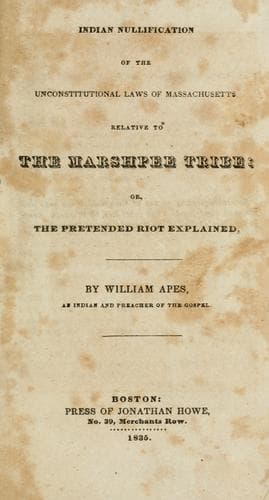
Indian Nullification of the Unconstitutional Laws of Massachusetts Relative to the Marshpee Tribe: Or, the Pretended Riot ExplainedApess, William
History
Indian Nullification of the Unconstitutional Laws of Massachusetts Relative to the Marshpee Tribe: Or, the Pretended Riot Explained
Apess, William
Indians of North America -- Legal status, laws, etc.; Mashpee Indians -- Land tenure; Mashpee Indians -- Legal status, laws, etc.
On the other side, opposite to their memorial for
self-government, is the remonstrance of _Nathan Pocknet_
and forty-nine others, the same Nathan Pocknet, who in
1818 petitioned for the removal of the Overseership. This
remonstrance was not prepared by the Indians. It came wholly
from the Rev. Mr. Fish, and the Overseers. It speaks of the
"unprecedented impudence" of the Indians, and mentions a
"_Traverse Jury_." No one who signed it, had any voice in
preparing it. It shows ignorance of the memorial of the tribe,
by supposing they ask for liberty to sell their lands; and
ignorance of the law, by saying that the Overseers have not
power to remove nuisances from the plantation.
This remonstrance is signed by fifty persons, sixteen males
and thirty-four females; seventeen can write. Of the signers,
_ten_ belong to Nathan Pocknet's family. Ten of the males
are Proprietors, of whom two are minors, and one a person non
compos. Of the non-proprietors, one is a convict, recently
released from State prison, who has no right on the
Plantation. Two of the Proprietors, who signed this
remonstrance, (John Speen and Isaac Wickham,) have since
certified that they understood it to be the petition for Mr.
Fish, to retain his salary, but that they are entirely opposed
to having Overseers and to the present laws.
Thus it is shown that out of the whole Plantation of 229
Proprietors, but _five_ men could be induced, by all the
influence of the Minister and the Overseer, to sign in favor
of having the present laws continued, and but _eleven_ men out
of the whole population of 312. The signers to the memorial
for a change of the laws are a majority of all the men, women
and children belonging to the Plantation, at home and abroad.
Another document against the Indians who ask for their
liberty, is the memorial of the Rev. Phineas Fish, the
missionary. Of the unassuming piety, the excellent character,
and the sound learning of that reverend gentleman, I cannot
speak in too warm terms. I respect him as a man, and honor him
as a devoted minister of the gospel. But he is not adapted
to the cultivation of the field in which his labors have been
cast. Until I read this memorial, I should not have believed
that a severe expression could have escaped him. I regret the
spirit of that memorial, and in its comparison with that of
the Indians, I must say it loses in style, in dignity and in
Christian temper.
In this memorial, Mr. Fish urges upon the Legislature the
continuance of the laws of guardianship as they now are, and
especially the continuance of the benefits he derives from the
property of the plantation. What are the reasons he gives for
this. Do they not look exclusively to his own benefit, without
regard to the wishes of the Indians?
Public-domain text, read in full here on John Shaqi.
Reviews
Reviews
No reviews yet
Be the first to share your thoughts on this work.
Elsewhere in the archive
Join the Discussion
Join the discussion
Sign in to leave a comment or review.
Sign InorCreate an account