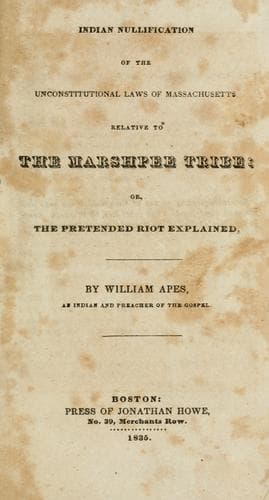
Indian Nullification of the Unconstitutional Laws of Massachusetts Relative to the Marshpee Tribe: Or, the Pretended Riot ExplainedApess, William
History
Indian Nullification of the Unconstitutional Laws of Massachusetts Relative to the Marshpee Tribe: Or, the Pretended Riot Explained
Apess, William
Indians of North America -- Legal status, laws, etc.; Mashpee Indians -- Land tenure; Mashpee Indians -- Legal status, laws, etc.
He states, as the result of his ministry, twenty members of
the tribe added to his church in _twenty-two_ years. This
single fact proves that his ministry has failed of producing
any effect at all proportioned to the cost it has been to the
Indians. Not from want of zeal or ability, perhaps, but from
want of adaptation. If not, why have other preachers been so
much more successful than the missionary. There never has been
a time that this church was not controlled by the whites.
Mr. Fish now has but five colored members of his church, and
sixteen whites. Of the five colored persons, but one is a
male, and he has recently signed a paper saying he has been
deceived by Mr. Fish's petition, which he signed, and that he
does not now wish his stay any longer among them.
On the other hand, "blind Jo," as he is called, a native
Indian, blind from his birth, now 28 years of age, has
educated himself by his ear and his memory, has been regularly
ordained as a Baptist minister, in full fellowship with that
denomination, and has had a little church organized since
1830. The Baptist denomination has existed on the plantation,
for forty years, but has received no encouragement. Blind
Jo has never been taken by the hand by the missionary or the
Overseers. The Indians were even refused the use of _their_
Meeting-house, for the ordination of their blind minister, and
he was ordained in a private dwelling. Though not possessing
the eloquence of the blind preacher, so touchingly described
in the glowing and chaste letters of Wirt's British Spy,
yet there is much to admire in the simple piety and sound
doctrines of "Blind Jo;" and he will find a way to the hearts
of his hearers, which the learned divine cannot explore.
There is another denomination on the plantation, organized
as "The Free and United Church," of which William Apes is the
pastor. This denomination Mr. Fish charges with an attempt
to _usurp_ the parsonage, wood-land and the Meeting-house; he
denounces, as a "_flagrant act_," the attempt of the Indians
to obtain the use of _their own Meeting-house_, and appeals
to the sympathies of the whole civilized community to maintain
_by law_ the Congregational worship, which, he says, "is the
most ancient form of religious worship there!" "Why should
Congregational worship be excluded to make room for others?"
asks the Rev. Mr. Fish. "Where will be the end of vicissitude
on the adoption of such a principle, and how is it possible,
amid the action of rival _factions_, for pure religion to be
promoted." [Pages 7, 8, 9, of Mr. Fish's memorial. Senate, No.
17.] Is this language for a Christian minister to address
to the Legislature of Massachusetts? To petition for an
established Church in Marshpee? Can he ever have read the
third Article of the Bill of Rights, as amended?
Public-domain text, read in full here on John Shaqi.
Reviews
Reviews
No reviews yet
Be the first to share your thoughts on this work.
Elsewhere in the archive
Join the Discussion
Join the discussion
Sign in to leave a comment or review.
Sign InorCreate an account