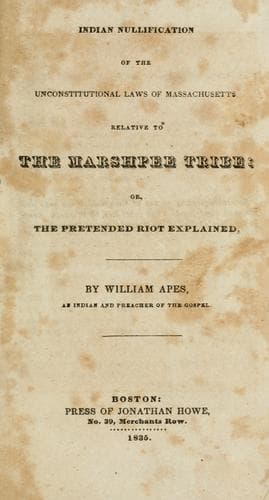
Indian Nullification of the Unconstitutional Laws of Massachusetts Relative to the Marshpee Tribe: Or, the Pretended Riot ExplainedApess, William
History
Indian Nullification of the Unconstitutional Laws of Massachusetts Relative to the Marshpee Tribe: Or, the Pretended Riot Explained
Apess, William
Indians of North America -- Legal status, laws, etc.; Mashpee Indians -- Land tenure; Mashpee Indians -- Legal status, laws, etc.
I regret too, the unkind allusion in the Rev. Mr. Fish's
memorial to Deacon Coombs, the oldest of the Marshpee
delegation, formerly his deacon, and the last proprietor to
leave him. He says the deacon "once walked worthy of his holy
calling." Does he mean to insinuate he does not walk worthily
now? I wish you, gentlemen, to examine Deacon Coombs, who is
present, to inquire into his manner of life, and see if you
can find a Christian with a white skin, whose heart is purer,
and whose walk is more upright, than this same Deacon Coombs.
In point of character and intelligence, he would compare
advantageously with a majority of the Selectmen in the
Commonwealth.
With the religious concerns of Marshpee, I have no wish to
interfere. I only seek to repel intimations that may operate
against their prayer for the liberties secured by the
Constitution. Neither do I stand here to defend Mr. Apes, who
is charged with being the leader of the "sedition." I only
ask you to look at the historical evidence of the existence of
discontent with the laws, ever since 1693, and ask if Mr.
Apes has been the author of this discontent. Let me remind
you also, of the fable of the Huntsman and the Lion, when
the former boasted of the superiority of man, and to prove it
pointed to a statue of one of the old heroes, standing upon a
prostrate lion. The reply of the noble beast was, "there
are no _carvers_ among the lions; if there were, for one man
standing upon a lion, you would have twenty men torn to pieces
by lions." Gentlemen, by depressing the Indians, our laws have
taken care that they should have no _carvers_. The whites have
done all the _carving_ for them, and have always placed them
_undermost_. Can we blame them, then, that when they found
an educated Indian, with Indian sympathies and feelings, they
employed him, to present their complaints, and to enable them
to seek redress? Look at this circumstance, fairly, and I
think you will find in it the origin of all the prejudice
against William Apes, which may be traced to those of the
whites who are opposed to any change in the present government
of Marshpee. If aught can be shown against him, I hope it
will be produced here in proof, that the Indians may not be
deceived. If no other proof is produced, except his zeal in
securing freedom for the Indians, are you not to conclude that
it cannot be done. But his individual character has nothing to
do with the merits of the question, though I here pronounce it
unimpeached.
Public-domain text, read in full here on John Shaqi.
Reviews
Reviews
No reviews yet
Be the first to share your thoughts on this work.
Elsewhere in the archive
Join the Discussion
Join the discussion
Sign in to leave a comment or review.
Sign InorCreate an account