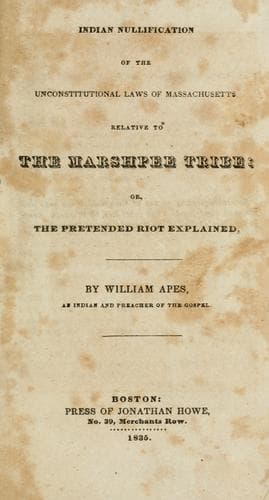
Indian Nullification of the Unconstitutional Laws of Massachusetts Relative to the Marshpee Tribe: Or, the Pretended Riot ExplainedApess, William
History
Indian Nullification of the Unconstitutional Laws of Massachusetts Relative to the Marshpee Tribe: Or, the Pretended Riot Explained
Apess, William
Indians of North America -- Legal status, laws, etc.; Mashpee Indians -- Land tenure; Mashpee Indians -- Legal status, laws, etc.
I will allude to but one other suggestion in the memorial
of the Rev. Mr. Fish, [page 10.] To show the necessity of
continuing the present laws, he says, "already do we witness
the force of example in the visible increase of crime. But a
few weeks since, a peaceable family was fired in upon, during
their midnight repose; while I have been writing, another has
been committed to prison for a high misdemeanor."
Now what are the facts, upon which this grave allegation
against the whole tribe is founded. True, a ball was fired
into a house on the plantation, but without any possible
connection with the assertion of their rights by the Indians,
and to this day it is not known whether it was a white man or
an Indian who did it. The "high misdemeanor," was a quarrel
between Jerry Squib, an Indian, and John Jones, a white
man. Squib accused Jones of cheating him in a bargain, when
intoxicated, and beat him for it. The law took up the Indian
for the assault, and let the white man go for the fraud.
Respecting then, as we all do, the personal character of the
missionary, can you answer his prayer, to continue the present
government, in order to protect him in the reception of
his present income from the lands of the Indians? Are the
interests of a whole people to be sacrificed to one man?
What says the Bill of rights? "Government is instituted for
the common good, for the protection, safety, prosperity, and
happiness of the _people_, and not for the _profit_, honor or
_private interest_ of any _one_ man, family, or class of men."
I have now only to consider the report of the Commissioner,
Mr. Fiske, who visited Marshpee in July last. The
impartiality, candor and good sense of that report, are highly
honorable to that gentleman. Deriving his first impressions
from the Overseers and the whites, and instructed as he was
with strong prepossessions against the Indians, as rebels
to the State, the manner in which he discharged that duty,
deserves a high encomium. He has my thanks for it, as a friend
of the Indians. As far as the knowledge of the facts
enabled the Commissioner to go, in the time allowed him, the
conclusions of that report, substantiate all the positions
taken in defence of the rights of the Indians. The
Commissioner was instructed by the then Governor Lincoln, to
inform the Indians that the government had no other object
than their best good; "let them be convinced that their
grievances will be inquired into, and a _generous_ and
_paternal_ regard be had to their condition." They were so
convinced, and they come here now, for a redemption of this
pledge.
Public-domain text, read in full here on John Shaqi.
Reviews
Reviews
No reviews yet
Be the first to share your thoughts on this work.
Elsewhere in the archive
Join the Discussion
Join the discussion
Sign in to leave a comment or review.
Sign InorCreate an account