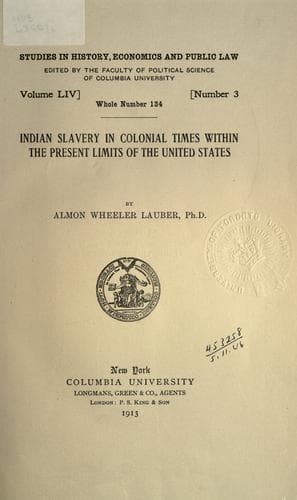
Indian slavery in colonial times within the present limits of the United StatesLauber, Almon Wheeler
History
Indian slavery in colonial times within the present limits of the United States
Lauber, Almon Wheeler
Indians of North America; Indians, Treatment of -- United States; Slavery -- United States; Thesis (Ph. D.)
Their love of strong drink not infrequently led the Indians into
temporary servitude, and served as a means by which the colonists, if
so minded, could force them into that condition. On one occasion Boston
was building a fort on an island in the harbor. Wages were high and
economy was desirable. The general court, therefore, ordered that for
drunkenness the Indians should not be whipped, but sent to this island
to work for ten days. The Indians protested and preferred whipping as
punishment, but their complaint received no attention.[703]
On March 8, 1683, the Plymouth general court decreed that a certain
Indian should serve as a slave for a specified time because of a
judgment against him.[704] At a council held in Boston, also, June 14,
1686, upon notification of the keeper of the prison that a sentence
of transportation of an Indian had not been carried into effect, the
treasurer was ordered to sell the Indian for a period not exceeding
seven years in satisfaction of the judgment against him.[705] The
Massachusetts council records of January 18, 1695, tell of an Indian
accused of “corresponding with and adhering to the Indian enemy” who
was transported and sold for the offense.[706] A similar instance
occurred in 1696, when an Indian was condemned “to be transported
beyond the seas as a dangerous person and sold”.[707] On December
1, 1705, the Massachusetts deputies sent in a bill providing that
fornication or marriage of white men with negroes or Indians should
be punished by selling the colored offenders out of the colony as
slaves. Through the intercession of Samuel Sewall, the Indians were
dropped from the bill which was then passed as applying to blacks and
mulattoes.[708] The records mention other instances in 1713[709] and
1776[710] when Indians were sold as punishment for crime, the latter
case being one of theft. An incident occurred in 1721 when the sentence
of an Indian imprisoned in Boston was changed from imprisonment to
a term of servitude.[711] Another Indian, in 1727, was sold for a
term of years to a resident of the colony to serve a sentence for
debt.[712] In 1739, on petition of the sheriff of Barnstaple county,
the Massachusetts general court impowered the justices of that county
to sell an Indian prisoner convicted of manslaughter and sentenced to
imprisonment “to any of his majesty’s good subjects for a term not
exceeding ten years, for the most he will fetch”, in order to get money
to pay the cost of prosecuting the prisoner and the charges of his
imprisonment.[713]
Public-domain text, read in full here on John Shaqi.
Reviews
Reviews
No reviews yet
Be the first to share your thoughts on this work.
Elsewhere in the archive
Join the Discussion
Join the discussion
Sign in to leave a comment or review.
Sign InorCreate an account