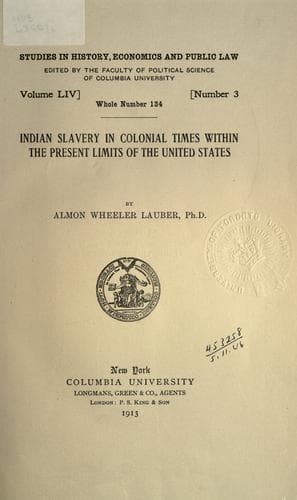
Indian slavery in colonial times within the present limits of the United StatesLauber, Almon Wheeler
History
Indian slavery in colonial times within the present limits of the United States
Lauber, Almon Wheeler
Indians of North America; Indians, Treatment of -- United States; Slavery -- United States; Thesis (Ph. D.)
The Indians of Rhode Island gave much trouble by stealing the goods
and cattle of the colonists. To prevent it, a law was passed, 1659, to
the effect that, if the damage exceeded twenty shillings, the convict
might be sold as a slave to any English plantation abroad unless he
made restitution.[714] Instances are not lacking in which the law of
1659 was put into effect. On one occasion (between 1671 and 1685) an
Indian convicted of breaking into a house and of beating and wounding
a servant, was sentenced to pay a fine, or, if payment were not made
in three months, to be sold as a slave in Barbadoes.[715] In 1676, the
general court provided that all Indians who should come upon any island
in the bay, must have written permission so to do from the committee
appointed to dispose of Indians, without which they would be liable to
be sold into servitude.[716]
The first code of Connecticut laws, 1650, followed the Massachusetts
Body of Liberties in authorizing enslavement as a mode of
punishment.[717] In 1650, certain Indians who failed to make
satisfaction for injuries were ordered to be seized and delivered to
the injured party, “either to serve or to be shipped out ... as the
case will justly bear”.[718] In 1660, the general court was empowered
by the United Colonies to send a company of men to obtain satisfaction
from the Narraganset for certain depredations upon the settlers. Four
of the guilty Indians were to be demanded and sent to Barbadoes to be
sold as slaves.[719]
Not only did the New England colonies take separately such legislative
action regarding the enslavement of Indians, but Plymouth,
Massachusetts, Connecticut, and New Haven acting together as the New
England Confederation, took similar action. Alleged trespassing of
Indians upon English territory, and the fear of a Narraganset war,
led the United Colonies, in 1646, to pass an order authorizing, upon
complaint of trespass by Indians, the seizure of any of them who should
“entertain, protect or rescue the offender”. “And because it will be
chargeable keeping Indians in prison, and if they should escape, they
are like to prove more insolent and dangerous after, that upon such
seizure, the delinquent or satisfaction be demanded of the sagamore
or plantation of Indians guilty or accessory as before, and if it be
denied, that the magistrates of the jurisdiction deliver up the Indians
seized to the party or parties indamaged, either to serve or to be
shipped out in exchange for negroes as the case will justly bear.”
The commissioners agreed that this measure, though just, was severe,
and that it might lead to the Indians seizing the English in return;
but they could see no better means of preserving the peace of the
colony. As a measure of fairness, therefore, they decreed that before
any seizure of Indians was made, a copy of the declaration should be
published and given to the particular sagamore. Copies were accordingly
given to four leading sachems.[720]
Public-domain text, read in full here on John Shaqi.
Reviews
Reviews
No reviews yet
Be the first to share your thoughts on this work.
Elsewhere in the archive
Join the Discussion
Join the discussion
Sign in to leave a comment or review.
Sign InorCreate an account