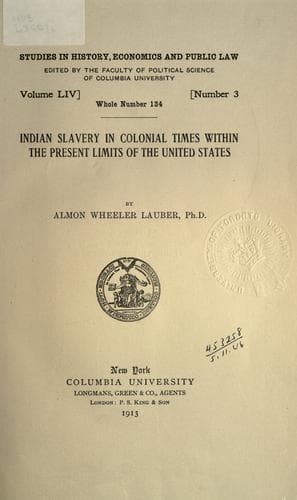
Indian slavery in colonial times within the present limits of the United StatesLauber, Almon Wheeler
History
Indian slavery in colonial times within the present limits of the United States
Lauber, Almon Wheeler
Indians of North America; Indians, Treatment of -- United States; Slavery -- United States; Thesis (Ph. D.)
A further process of enslavement was connected with questions of birth.
By the recognized common law of nations, the civil law, and the Jewish
law, the children of a slave mother became at birth the property of
the mother’s owner. Nobody thought of the children of slaves being
free. Yet, to make certainty doubly sure, the colonial laws from time
to time considered the matter and declared the common law a part of
colonial legislation.[721] South Carolina, for example, by an act of
1712,[722] repeated in 1722,[723] and 1735,[724] declared that, with
the exception of certain individuals freed by the government, “all
negroes, mulattoes, mustizoes, or Indians which at any time heretofore
have been sold, or now are held or taken to be, or hereafter shall be
bought and sold as slaves, are hereby declared slaves; and they and
their children, are hereby made and declared slaves to all intents and
purposes.” Another act of 1740, though worded differently, decreed a
similar condition for the children of negro, mulatto, mustee and Indian
slave mothers.[725] In 1705, Virginia similarly declared all children
bond or free according to the condition of their mothers;[726] and,
in 1723, decreed that children of female mulattoes or Indians obliged
by law to serve till the age of thirty or thirty-one should serve the
master or mistress of such mulatto or Indian until they should attain
the same age as that up to which the mother was obliged by law to
serve.[727]
A Maryland act of 1663 differs from the acts just mentioned by stating
that “all children born of any negro or other slave, shall be slaves
as their fathers were for the term of their lives.” Another section
of this same act provides that “whatsoever freeborn woman shall
intermarry with any slave, from and after the last day of the present
assembly, shall serve the master of such slave during the life of her
husband; and that all the issue of such free-born woman, so married,
shall be slaves as their fathers were.”[728] Though the law was of
brief duration, persons born of the union between slaves and free
white women, and the descendants of such persons, were held in slavery
down to 1791, when the highest court of the state decided that for
want of proof concerning the white woman who originally married a
slave, her descendants were not slaves, and could not be legally held
as such.[729] A later Maryland act, June 2, 1692, provided that all
children born or thereafter to be born of slaves within the province
were to be slaves for the term of their natural lives.[730] Nothing is
said in the act of children one of whose parents was free. The act was
repealed in 1715.[731] New York, on its own part, in 1706, decreed that
any negro, Indian, mulatto or mustee child should follow the condition
of the mother and be esteemed a slave “to all intents and purposes
whatsoever.”[732] Frequent incidental mention, also, is found in the
documents of the time and in newspaper advertisements to slaves “born
Public-domain text, read in full here on John Shaqi.
Reviews
Reviews
No reviews yet
Be the first to share your thoughts on this work.
Elsewhere in the archive
Join the Discussion
Join the discussion
Sign in to leave a comment or review.
Sign InorCreate an account