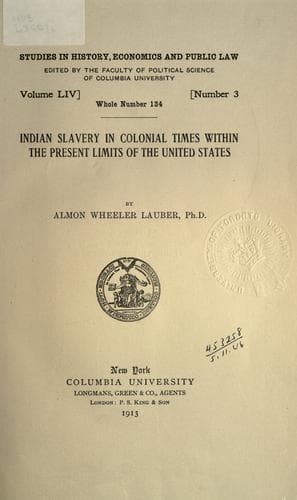
Indian slavery in colonial times within the present limits of the United StatesLauber, Almon Wheeler
History
Indian slavery in colonial times within the present limits of the United States
Lauber, Almon Wheeler
Indians of North America; Indians, Treatment of -- United States; Slavery -- United States; Thesis (Ph. D.)
Indians. When such was the case, however, according to a strict legal
interpretation, any subject Indian, if enslaved, had the right to
demand his freedom from the colonial courts. Such an instance existed
in the case of Virginia where the acts of 1655 and 1661 specifically
forbade Indian slavery and guaranteed to the subject Indians all the
rights of servants.[739]
The recognition of Indian as well as negro slavery by customary law
came somewhat earlier than by statute law. With the extension of
the period of servitude to a life term, the change from servitude
to slavery was practically completed so far as customary law was
concerned. Only the enactment of legal provisions sanctioning the
change was necessary to complete the process. The common use in
subsequent law of the terms “servant for life”, “perpetual servant”,
and “bond servant” as synonymous with the term “slave” shows how
little change was really effected in the condition of the servant.
Such change consisted chiefly, from the standpoint of the master,
in the extension of his right to service, and consequently in the
extension of his obligation of protection and maintenance, and what was
still more important, in the acquisition of the right of possession
of the offspring of his slaves. From the standpoint of the slave,
it meant little more than the loss of the right to ultimate liberty,
political and civil, and the extension of his right to protection and
maintenance.[740]
The legislation which marked the changing status varied in nature in
the several colonies. In certain colonies the slavery status was simply
recognized as being in existence by certain acts relating to slaves,
without any formal declaration to the effect that Indians held in
servitude should be considered slaves. In other colonies the condition
of slavery as applied to Indians was legalized by general acts relating
to slavery in general, and not specifying either Indians or negroes.
In still other colonies the holding of Indians in a condition of
actual slavery was legalized by legislative acts relating directly to
Indians. An act of this latter character was passed by New York in 1678
declaring that all Indians that should come to, or be brought into
the province at any time during the succeeding six months, should be
sold as slaves for the benefit of the government.[741] South Carolina,
in an act of 1712 relating to the “better ordering and governing of
negroes and slaves”, provided that “all negroes, mulattoes, mestizoes
or Indians which have at any time heretofore been sold, or now are held
and taken to be, or hereafter shall be brought and sold as slaves, are
hereby declared slaves to all intents and purposes; excepting all such
negroes, mulattoes, mestizoes or Indians which heretofore have been,
or hereafter shall be for some particular merit, made and declared
free, either by the Governor and Council of this province, or by their
respective owners and masters; and also, excepting all such negroes,
Public-domain text, read in full here on John Shaqi.
Reviews
Reviews
No reviews yet
Be the first to share your thoughts on this work.
Elsewhere in the archive
Join the Discussion
Join the discussion
Sign in to leave a comment or review.
Sign InorCreate an account