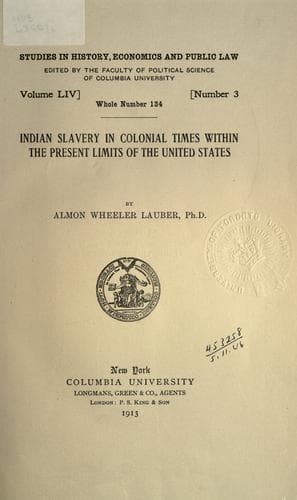
Indian slavery in colonial times within the present limits of the United StatesLauber, Almon Wheeler
History
Indian slavery in colonial times within the present limits of the United States
Lauber, Almon Wheeler
Indians of North America; Indians, Treatment of -- United States; Slavery -- United States; Thesis (Ph. D.)
mulattoes, mestizoes or Indians as can prove they ought not to be sold
as slaves”.[742] The acts, already mentioned in other connections,
authorizing the enslavement of Indian captives taken in war, the
holding in slavery of such captives when obtained in trade from sources
outside the colony, and the enslavement of free Indians by the colonial
authorities as punishment for misdemeanors and crimes, are also cases
in point.
From the standpoint of English law the action of the colonial
legislatures enacting the slavery status had no legal sanction. It
was based on the interpretation of the common law of nations, that
is, it was carried on in accordance with a “law not promulgated
by legislation, and rested upon prevalent views of universal
jurisprudence, or the law of nations supported by the express or
implied authority of the home government” concerning the institution
of slavery.[743] So the colonies, by a gradual process of changing
conditions and legal enactments, substituted the slavery status for
the servitude status without molestation from the home government,
which was interested in colonial slave conditions and legislation
only when the African slave trade was involved. So long, therefore,
as the enactment of colonial laws decreeing the slavery status did
not interfere with that trade, the home government gave no attention
to the matter. As for Indian slavery _per se_, if England had given
it any attention whatever, she would probably have considered it a
purely colonial matter. Since it was never sufficiently extensive to
interfere with negro slavery and the slave trade, it never received any
attention from the home government, and so existed as legal because
never declared illegal. An authority on the legal status of early
American slavery states: “It may be laid down as a legal axiom, that in
all governments in which the municipal regulations are not absolutely
opposed to slavery, persons already reduced to that state may be held
in it, and we also assume, as a first principle, that slavery has been
permitted and tolerated in all the colonies established in America by
European powers, as relates to blacks and also as relates to Indians
in the first periods of conquest and colonization. This accounts in
a measure for the absence of any legislative act of European powers
for intruding slavery into the American dominions.”[744] Hence it
followed that the English colonial charters authorizing the colonial
legislatures to make laws, gave no license as such to enslave.[745]
With the change from the status of servitude to the status of slavery,
certain of the attributes of the former condition were continued and
connected with the latter. Chief of these, and the fundamental idea on
which the change was effected, was the conception of property right
which, from the idea of the ownership of an individual’s service
resting upon contract implied or expressed, came to be that of the
ownership of an individual’s person.
Public-domain text, read in full here on John Shaqi.
Reviews
Reviews
No reviews yet
Be the first to share your thoughts on this work.
Elsewhere in the archive
Join the Discussion
Join the discussion
Sign in to leave a comment or review.
Sign InorCreate an account