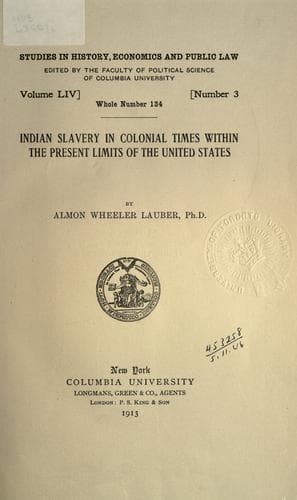
Indian slavery in colonial times within the present limits of the United StatesLauber, Almon Wheeler
History
Indian slavery in colonial times within the present limits of the United States
Lauber, Almon Wheeler
Indians of North America; Indians, Treatment of -- United States; Slavery -- United States; Thesis (Ph. D.)
The proximity of the Indian tribes to the colonists, furthermore,
afforded a condition most suitable for the escape of Indian slaves.
Individual testimony, frequent advertisements in the colonial
newspapers giving descriptions of fugitive Indian slaves and offering
rewards for their capture and return, and the amount of colonial
legislation concerning both negro and Indian runaway slaves, show that
Indians held in servitude took frequent advantage of the opportunities
at hand for their escape, and that their owners used all possible
means to regain their lost property. At the time following the Pequot
War, Mason complained of the tendency to run away shown by the Pequot
slaves in the colonies.[758] The Indians enslaved after King Philip’s
War likewise escaped. Mayhew tells of runaway Indian slaves in
Massachusetts in 1690.[759] In this same year one Isaac Morrill of New
Jersey was arrested at Newbury, Massachusetts, for enticing Indian and
negro slaves to run away.[760]
The _Boston News Letter_ came into existence, 1704,[761] at about the
time when Indian slaves began to be brought into the northern colonies
from the Spanish islands and from the Carolinas. Rarely was there an
issue of that or the other Massachusetts newspapers from that time down
to the Revolutionary period which did not contain an advertisement
for a runaway Indian slave. Sometimes the same advertisement was
repeated in two or three successive issues,[762] and was often
inserted in more than one newspaper. For the capture and return of the
fugitives, rewards were offered, sometimes indefinite in nature as
“suitable rewards”,[763] sometimes of stated amounts as £3.[764] forty
shillings,[765] twenty shillings,[766] £6,[767] £20,[768] £5,[769]
£7,[770] £15,[771] four pistoles,[772] fifty shillings.[773] These
advertisements relate for the most part to fugitive men and boy Indian
slaves, but advertisements relating to runaway women Indian slaves are
not lacking.[774] The escapes appear for the most part, though not
always, to have been made singly. One advertisement shows two Indian
men, two Indian women and an Indian boy belonging to different persons
to have escaped together.[775] Captains of vessels were often cautioned
in the advertisements against carrying away such fugitive slaves, and
any person harboring them or aiding them to escape was threatened with
full penalty of the law.
All the colonies enacted fugitive slave laws. Some of these laws were
applied to slaves in general, some to negroes and “other slaves,”
still others to negro, mulatto and Indian slaves. The colonies where
slavery was of greatest extent had the most extensive and elaborate
laws on the subject, and those colonies where Indian slavery existed
to any considerable extent included the term “Indian slaves” in their
laws. Pennsylvania made but little provision regarding runaway slaves.
Maryland concerned itself more largely with servants.
Public-domain text, read in full here on John Shaqi.
Reviews
Reviews
No reviews yet
Be the first to share your thoughts on this work.
Elsewhere in the archive
Join the Discussion
Join the discussion
Sign in to leave a comment or review.
Sign InorCreate an account