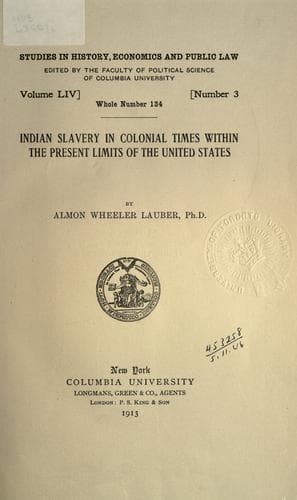
Indian slavery in colonial times within the present limits of the United StatesLauber, Almon Wheeler
History
Indian slavery in colonial times within the present limits of the United States
Lauber, Almon Wheeler
Indians of North America; Indians, Treatment of -- United States; Slavery -- United States; Thesis (Ph. D.)
Some of these laws did not define the term “runaway slave”. Others in
an attempt to avoid confusion gave clear explanations of the term. Such
an act was passed by Connecticut in 1690, specifying that any Indian,
mulatto or negro servants and slaves wandering outside the place to
which they belonged without a ticket of leave or pass in writing from
some assistant or justice of the peace or from their owner, were to
be considered runaways and treated as such.[776] New Jersey, in 1713,
considered as runaways any negro, mulatto or Indian slave who was five
miles from his master’s habitation without written leave of absence
from his owner, and any such slave found in New Jersey but belonging to
another province was declared a runaway.[777] South Carolina, by the
act of 1690, considered as a runaway any negro or Indian slave absent
from his master’s plantation (no distance specified), without a written
ticket of leave unless in company with a white man.[778]
To discourage aid and assistance being given fugitive slaves, the
colonies specified by legislative acts the punishment to follow such
offense. On June 14, 1705, Lord Cornbury, in his opening speech to the
New York assembly, expressed his opinion regarding the necessity for
passing an act to prevent negro, Indian and mulatto slaves running away
from their masters.[779] An act of the common council of Albany, 1686,
forbade all persons harboring negro or Indian slaves in their houses
without the owners’ consent.[780] Pennsylvania, 1726, decreed a fine
of five shillings for the first hour and one shilling for every hour
afterward that any person should harbor or entertain any runaway negro,
Indian or mulatto slave.[781] Virginia, by the act of 1705, specified
a fine of £100 for any shipmaster transporting any negro, mulatto or
Indian slave out of the colony without permission of the owner.[782]
South Carolina, also, by an act of 1690, levied forty shillings fine
on any one not attempting to apprehend a negro or Indian slave coming
into his plantation without a ticket of leave from his master or not
accompanied by a white man.[783]
Public-domain text, read in full here on John Shaqi.
Reviews
Reviews
No reviews yet
Be the first to share your thoughts on this work.
Elsewhere in the archive
Join the Discussion
Join the discussion
Sign in to leave a comment or review.
Sign InorCreate an account