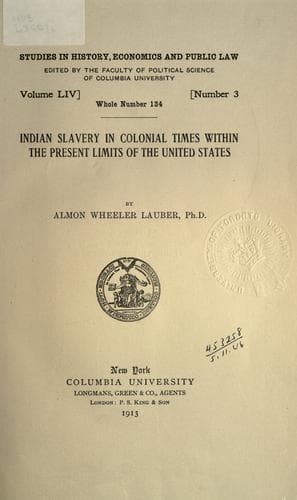
Indian slavery in colonial times within the present limits of the United StatesLauber, Almon Wheeler
History
Indian slavery in colonial times within the present limits of the United States
Lauber, Almon Wheeler
Indians of North America; Indians, Treatment of -- United States; Slavery -- United States; Thesis (Ph. D.)
The Spanish Indians were considered especially undesirable.
Accordingly, an act of 1722 imposed upon all such Spanish Indians,
negroes, mulattoes and mustees imported, a duty of £50 current money of
the province.[842] The duty on Indian slaves was levied without regard
to age, while that on negro slaves was graduated according to age. A
report to the Board of Trade, February 2, 1736, gave the duty on negro
slaves imported from Africa above ten years old as £10; under ten years
old, £5; and on all Indians imported, £50 each.[843] The following
was the tariff schedule on negroes and Indians in force in 1775.[844]
“Indians imported as slaves, each £50. Negroes or slaves, four feet two
inches or more in height, each £10. Negroes, under four feet two, and
above three feet two inches, each £5. Negroes, under four feet two, and
above three feet two inches, sucking children excepted, each 2£ 10s.
Negroes or slaves from any of his Majesty’s plantations in America,
where such slaves have been for six months or more, unless imported by
the owners with design to be employed on their own account, besides the
above £10, £5, and £2 10s., each slave, £50.”
The earliest act passed in Virginia to check the importation of
negroes, that of 1699, imposed a duty of fifteen shillings per poll
upon every servant not born in England or Wales, and twenty shillings
for every negro or other slave imported into the colony. This duty was
continued or increased by a number of temporary acts between 1669 and
1776.[845] The acts were worded “all slaves” or “negroes and other
slaves”. Thus import duties were levied upon Indian as well as negro
slaves. A statute of 1710 advanced the duty on negroes to £5 per head,
and placed a duty of twenty shillings on Indians imported by land.[846]
The difference in the amount of the duties is indicative of the
relative amount of danger attached by the colonists to the presence of
the two classes of slaves in the colony.
At the time of the Tuscarora War, the northern colonies realized fully
the possible results of the importation of the captives sold in their
communities. Some of them in consequence passed laws to ward off danger
from this source. In 1712, Rhode Island passed an act levying a duty
of forty shillings on every Indian brought into the colony. The act
was enforced by severe penalties, and every ship owner was required to
give bond to the amount of £50 for observing it.[847] New Hampshire,
in 1714, levied the heavy duty of £10 on the importation of any Indian
into the province.[848]
Public-domain text, read in full here on John Shaqi.
Reviews
Reviews
No reviews yet
Be the first to share your thoughts on this work.
Elsewhere in the archive
Join the Discussion
Join the discussion
Sign in to leave a comment or review.
Sign InorCreate an account