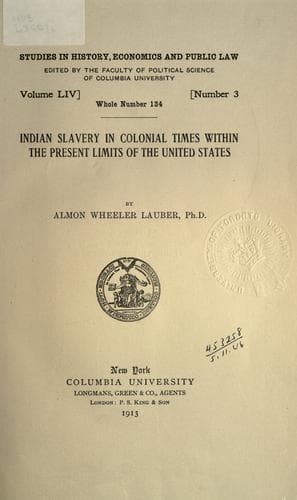
Indian slavery in colonial times within the present limits of the United StatesLauber, Almon Wheeler
History
Indian slavery in colonial times within the present limits of the United States
Lauber, Almon Wheeler
Indians of North America; Indians, Treatment of -- United States; Slavery -- United States; Thesis (Ph. D.)
In most of the colonies import duties, and in at least one instance
export duties, were levied on Indian slaves brought into or taken from
the colonies. Such duties were generally levied for self-defense,
though occasionally for revenue. During the colonial period England’s
interest in the African slave trade led her to take effective
measures to dispose of as many negroes as possible in the American
colonies. In course of time the colonists awoke to the danger which
might result from an excess of an ignorant servile class which in
some sections outnumbered the white population. Frequent attempts
were made in various colonies to check the importation of negroes
by levying import duties. At times Indians as well as negroes were
included in these laws. In their enactment it seems probable that the
colonial legislatures had a double purpose: to shut out undesirables
of both races, and to prevent the importation of negroes in the guise
of Indians. Real danger threatened the colonies from an excessive
importation of Indians as slaves, and an attempt was therefore made to
check it. In those colonies where import duties furnished a substantial
part of the colonial revenue, such duties were levied on Indian slaves
as well as on other property.
As early as 1698 the importation of negroes into South Carolina
had reached such proportions that the safety of the province was
considered endangered.[840] Attempts to check such importation were
accordingly made throughout the colonial period by levying import
duties. As the number of Indian slaves in the colony increased, they
too were included as a basis for duties. By the act of 1721, the
importation of negro, mulatto, mustee and Indian slaves (Spanish
Indians excepted) by their owners was permitted without duty, provided
such owner intended to settle in the colony and employ the slaves in
his own service. He was required, however, to take an oath that in case
he sold any of these slaves within twelve months after bringing them
into the colony, he would pay certain required duties.[841]
Public-domain text, read in full here on John Shaqi.
Reviews
Reviews
No reviews yet
Be the first to share your thoughts on this work.
Elsewhere in the archive
Join the Discussion
Join the discussion
Sign in to leave a comment or review.
Sign InorCreate an account