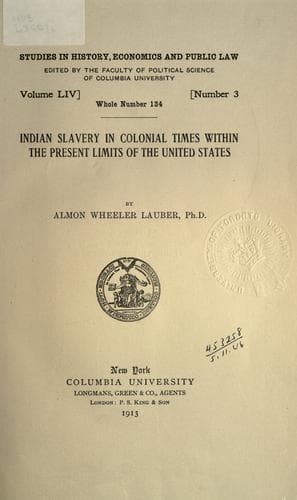
Indian slavery in colonial times within the present limits of the United StatesLauber, Almon Wheeler
History
Indian slavery in colonial times within the present limits of the United States
Lauber, Almon Wheeler
Indians of North America; Indians, Treatment of -- United States; Slavery -- United States; Thesis (Ph. D.)
The second cause for levying duties on Indians and other slaves was
to obtain revenue. Virginia in its legislation on the subject had
pretended at least that such was its purpose, and to carry out the
pretense had devoted the amounts thus obtained to meeting colonial
expenses.[855] Other colonies sought directly for revenue.[856] New
York was a striking example of such colonies. Import duties formed a
chief source of the colonial revenue, and slaves were enumerated among
the other commodities. The act of May 1, 1702, the first specifically
to mention Indian slaves, placed a duty of fifteen shillings on every
negro or Indian slave imported into the colony directly from their
place of residence, and thirty shillings upon every negro or Indian
slave not so imported.[857] The act which was to continue but two years
was found to be “of great use in this colony” and was accordingly
repeated on August 4, 1705, to continue seven years.[858] On June 24,
1719, it was again repeated to remain in effect from July 1, 1720, to
July 1, 1726.[859] Still other acts imposing similar duties were passed
as follows: in 1709, levying a duty of £3 on every negro imported into
the colony not directly from Africa and £3 on every other slave or
slaves not directly imported into the colony from Africa, the act to
continue till May 1, 1711;[860] on June 21, 1714, levying “a duty of
ten ounces of good plate” to be paid by the master or commander of any
vessel, or any other person importing slaves;[861] and on September
1, 1716, levying a duty of “ten ounces of good plate” on each negro,
Indian or mulatto slave imported into the colony from Africa in any
vessel not wholly owned by the people of the colony, and a like duty on
every negro, Indian or mulatto slave imported into the colony from any
part of the West Indies or any of the neighboring colonies, negroes or
other slaves going to and fro on their owners’ business excepted.[862]
On October 16, 1718, furthermore, it was decreed that no greater
duty was to be demanded on any slave brought into the colony directly
from Africa by a ship of Great Britain, than was to be demanded from
vessels wholly owned by inhabitants of the colony.[863] In June 17,
1726, on every Indian, negro or mulatto slave (male or female) of four
years of age or upwards imported by land or water from all places
other than Africa, a duty of £4 was laid.[864] On October 14, 1732,
a similar duty, regardless of the place from which the slave was
imported, was laid.[865] On November 28, 1734, on every negro, Indian
or mulatto slave above the age of fourteen and under the age of fifty,
during the period of ten years, the duty was fixed at “the quantity of
two pennyweight and twelve grains of Sivil pillar or Mexican plate,
or the sum of one shilling in Bills of Credit made current in this
colony.”[866] On December 16, 1737, finally, every negro, Indian or
mulatto slave above the age of four years imported directly from
Public-domain text, read in full here on John Shaqi.
Reviews
Reviews
No reviews yet
Be the first to share your thoughts on this work.
Elsewhere in the archive
Join the Discussion
Join the discussion
Sign in to leave a comment or review.
Sign InorCreate an account