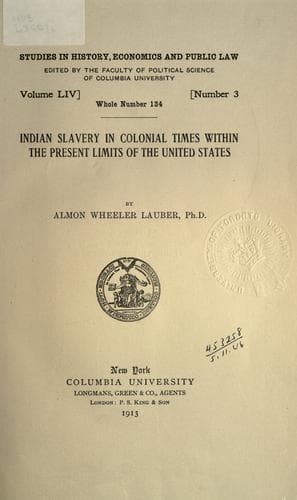
Indian slavery in colonial times within the present limits of the United StatesLauber, Almon Wheeler
History
Indian slavery in colonial times within the present limits of the United States
Lauber, Almon Wheeler
Indians of North America; Indians, Treatment of -- United States; Slavery -- United States; Thesis (Ph. D.)
Africa was made dutiable at the rate of five ounces of “Sivil pillar
or Mexican plate” or forty shillings in bills of credit current in
the colony; and for every such slave imported from all other places
by land or water, the sum of £4 in like money was exacted.[867] All
slaves belonging to the crew of any vessel, and slaves coming into the
colony from the neighboring colonies upon the service of their masters,
and all slaves under fourteen years of age were to be admitted free of
duty.[868] Any person coming into the colony alone, or with his or her
family to reside or visit in the colony, was allowed to bring slaves
for personal service, provided the owner gave sufficient security to
the treasurer within four days after the importation thereof, that,
whenever such slaves should be sold, the duty imposed by the act should
be paid within two days after such sale. Upon failure to pay such duty,
the owner or disposer of such slaves was to forfeit the sum of £10, the
slave or slaves, nevertheless, to be subject to the duty in question.
The duties provided for by the act were to remain in existence for the
period of one year.[869] At the expiration of the act it was continued
for another year, with certain amendments which did not relate to
slaves.[870] At the expiration of the specified period it was again
continued for another year or until the close of 1740,[871] when it
was again continued until December, 1741.[872] Such acts were then
passed by New York each year until the opening of the troubles of the
Revolutionary period.[873]
The number of Indians exported as slaves from South Carolina was larger
than that from any other colony. As a means of obtaining revenue, as
well as of attempting to check the business of the Indian traders, the
colony passed an act in 1703 which placed a duty upon Indian slaves
exported from the colony.[874] The traders were carefully instructed
not to attempt any such exportations without first paying at Charleston
the required duties, twenty shillings for each Indian exported[875].
CHAPTER X
+Methods of Employment+
Public-domain text, read in full here on John Shaqi.
Reviews
Reviews
No reviews yet
Be the first to share your thoughts on this work.
Elsewhere in the archive
Join the Discussion
Join the discussion
Sign in to leave a comment or review.
Sign InorCreate an account