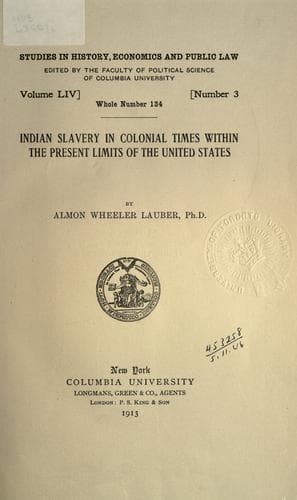
Indian slavery in colonial times within the present limits of the United StatesLauber, Almon Wheeler
History
Indian slavery in colonial times within the present limits of the United States
Lauber, Almon Wheeler
Indians of North America; Indians, Treatment of -- United States; Slavery -- United States; Thesis (Ph. D.)
and 1660, the people of Connecticut were employing the Mohegan Indians
in agricultural labor,[1158] and the use of hired Indians is reported
in the colony in 1774.[1159] By 1731 most of the Indians remaining
in Narragansett were servants in families.[1160] The records also of
Southampton, New York, show the employment of Indians for hire.[1161]
It was a part of the Puritan missionary scheme to win the heathen to
Christianity by employing them in their homes where they might be
brought into contact with the workings of the Christian religion. In
this manner they hoped to bring the savages to a state preparatory
to conversion.[1162] Something of the same purpose was intended by
the early Virginia colonists. Hence, in 1619, their first legislative
assembly ordered that every plantation should procure Indian youths
by just means for this purpose.[1163] In 1774, the governor of
Connecticut, in reply to various inquiries made by the home government
regarding conditions in the colony, stated that there were then
1,363 Indians in the colony, and that many of them dwelt in English
families.[1164] A similar statement was made in 1731 by Dean Berkeley
to the Society for the Propagation of the Gospel in Foreign Parts. He
declared that nearly all the native Indians of Rhode Island were at
that time servants or laborers for the English.[1165]
Some of the earliest of the indentured servants used in America,
moreover, were Indians. Reference has already been made to the
Massachusetts law of 1700 seeking to avoid the abuse of the custom.
In 1674, Plymouth passed a law providing that both Indians who lived
idly and those who did not pay their debts on conviction could be
handed over to those to whom they were indebted or to others as bond
servants.[1166] The Southold town records mention Indian apprentices
in 1678.[1167] Indentured male and female Indians existed in Salem
in 1685.[1168] Similar records of Indian apprentices and indentured
servants exist for Rhode Island,[1169] Connecticut,[1170] New
Jersey[1171] and New York.[1172] As a rule these bond servants were
young, for they were then more easily trained and were more tractable
and useful. In Virginia, in every agreement between Indian parents and
whites, a covenant had to be entered into providing that the child be
instructed in the Christian religion.[1173]
Public-domain text, read in full here on John Shaqi.
Reviews
Reviews
No reviews yet
Be the first to share your thoughts on this work.
Elsewhere in the archive
Join the Discussion
Join the discussion
Sign in to leave a comment or review.
Sign InorCreate an account