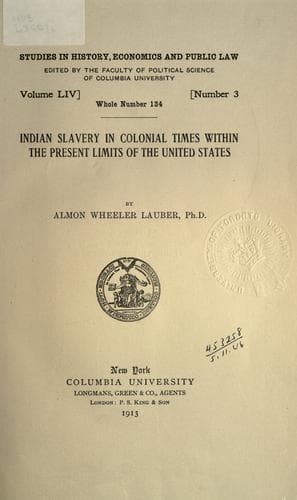
Indian slavery in colonial times within the present limits of the United StatesLauber, Almon Wheeler
History
Indian slavery in colonial times within the present limits of the United States
Lauber, Almon Wheeler
Indians of North America; Indians, Treatment of -- United States; Slavery -- United States; Thesis (Ph. D.)
checking the importation of Indians into the colony, is a transcript
of the Massachusetts act and shows that the colonists considered a
large Indian slave element in the population to be quite as undesirable
as did the people of Massachusetts.[1140] The New Hampshire act of
1714 cited as a reason for checking the importation of Indians: “the
over-great number and increase of such slaves within the province is
likely to prove of fatal and pernicious consequences to her majesty’s
subjects and interests here unless speedily remedied”.[1141] The
Rhode Island act of July 5, 1715, similarly was passed to prevent
the importation of Indian slaves, because “divers conspiracies,
insurrections, rapes, thefts, and other execrable crimes have been
lately perpetrated in this and the adjoining colonies by Indian slaves,
etc.”[1142]
Again, it seems not unlikely that the use of hired Indian servants may
have had something to do with the passing of Indian slavery, though
the influence was probably slight. Very early in the history of the
northern colonies, Indians were employed for wages. The need for
laborers could thus be partly met at very little cost. A Frenchman
residing in Boston in 1687, records the wages of such servants who
worked in the fields as “a shilling and a half a day and board which is
eighteen pence”.[1143]
The number of such Indians employed was generally small. As a hired
laborer the Indian was no more reliable or trustworthy than as a
slave. The keeping of Indians in the colonists’ families was always
considered to be more or less dangerous. Massachusetts, in 1631,[1144]
and Virginia, in 1661,[1145] required that all persons should get
special licenses before employing Indians. In 1634, Winthrop and his
son did so. Winthrop himself speaks of the “Indians which are in
our families”,[1146] and mention of his Indian servant is found in
other connections.[1147] As the colony grew stronger and the fear of
the Indians passed away, other leading men of Massachusetts, such as
Thomas Morton,[1148] the Reverend Mr. Pariss,[1149] Isaac Addington,
secretary of the Council of Safety in 1714,[1150] and John Eliot[1151]
employed such servants. The law was repealed in 1646, “there being
more use of encouragement thereto than otherwise.”[1152] That a
similar employment of Indians existed in Plymouth is seen by the
act of 1651 which shows the danger to the colony in providing such
servants with firearms.[1153] The Praying Indians hired themselves
to the whites.[1154] The New England whale fisheries employed hired
Indians, at least from 1670 to 1680.[1155] During the publication of
the New Testament in Massachusetts in 1661, and the translation of
the New and Old Testaments and the Psalms into the Indian language by
John Eliot in 1663, Green, the printer, was assisted in his work by
an Indian apprentice.[1156] In Little Compton, Massachusetts, hired
Indians were largely engaged in building stone fences.[1157] In 1659
Public-domain text, read in full here on John Shaqi.
Reviews
Reviews
No reviews yet
Be the first to share your thoughts on this work.
Elsewhere in the archive
Join the Discussion
Join the discussion
Sign in to leave a comment or review.
Sign InorCreate an account