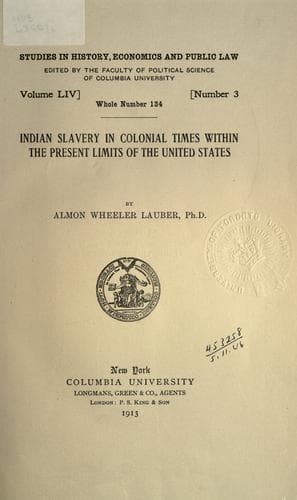
Indian slavery in colonial times within the present limits of the United StatesLauber, Almon Wheeler
History
Indian slavery in colonial times within the present limits of the United States
Lauber, Almon Wheeler
Indians of North America; Indians, Treatment of -- United States; Slavery -- United States; Thesis (Ph. D.)
Some idea of the relative values attached to Indian and negro slaves
may be obtained by a comparison of the prices for which they were
sold. In Massachusetts, for instance, record exists of the sale of
an Indian man slave in Newbury, in 1649, for “the quarter part of a
vessel”.[1181] Sewall records that on July 1, 1676, nine Indians were
sold for £30.[1182] An inventory of 1690, on the other hand, appraised
a single negro at £30.[1183] In the inventory of an estate in Ipswich,
in 1683, “Lawrence ye Indian” was valued at £4.[1184] In the same
town £5 was paid for an Indian boy and girl.[1185] The Reverend Mr.
Thacher of Milton, in 1674, paid £5 down and £5 more at the end of the
year for an Indian woman slave.[1186] An Indian girl brought £15 at
Salem in 1710;[1187] whereas in the case of a cargo of negroes brought
into Boston in 1727, as high as £80 was paid per head.[1188] In the
settlement of an estate in Newbury, an Indian slave was valued at an
early date at £20.[1189] In 1708, a South Carolina Indian boy was sold
for £35.[1190] In 1713, a Spanish Indian boy was sold in the same town
for £38.[1191] In 1725, a negro was sold in Newbury for £100, and three
other negroes were valued at £132 6s. 8d. in colonial currency.[1192]
In 1708, an Indian was sold at Salem for £32.[1193] An Indian girl was
sold in the same town in 1710 for £15.[1194] A negro was appraised in
the same town at £40.[1195] In 1764, a negro woman was sold for £8
13s. 4d.[1196] In Byfield a negro was listed in the inventory of an
estate in 1689 at £60.[1197] A negro given to Cotton Mather in 1706 was
purchased at an expense of £40 or £50.[1198] An Indian boy was valued
in Boston in 1721 at £20, and an Indian girl at £10.[1199]
In Rhode Island the prices of Indian slaves were lower than those
already mentioned, for here the Indians were sold into slavery for
limited periods only. The average price at which Indians “great and
small” were sold in the colony, was about thirty-two shillings. Some
of the lot brought into Rhode Island at the close of King Philip’s
War sold for twelve bushels of Indian corn, some for £2 10s. in
silver, some for 100 pounds of wool, one for three fat sheep, two for
twenty-two bushels of Indian corn.[1200] One sold in 1677 at Portsmouth
for £4 10s.[1201] Indian slaves appear among other effects in the
probate inventories. They were appraised at £8 and £10 each, while
negroes were valued at from £60 to £80,[1202] with an average price of
£50 for an able negro man and £40 for a woman.[1203] That is, a negro
laborer was reckoned as the equivalent of five or six Indians.[1204]
In 1718, three Indian children were worth £23.[1205] An inventory in
1723 valued the two years and ten months’ service of an Indian girl at
£5.[1206]
Public-domain text, read in full here on John Shaqi.
Reviews
Reviews
No reviews yet
Be the first to share your thoughts on this work.
Elsewhere in the archive
Join the Discussion
Join the discussion
Sign in to leave a comment or review.
Sign InorCreate an account