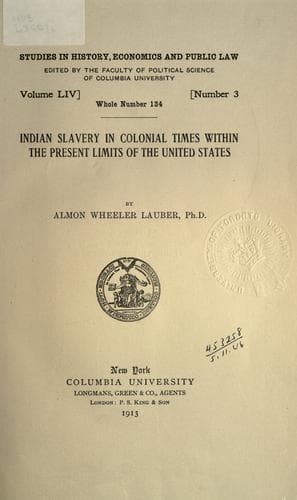
Indian slavery in colonial times within the present limits of the United StatesLauber, Almon Wheeler
History
Indian slavery in colonial times within the present limits of the United States
Lauber, Almon Wheeler
Indians of North America; Indians, Treatment of -- United States; Slavery -- United States; Thesis (Ph. D.)
The inventory of the estate of Gabriel Harris who died in 1684 in New
London, Connecticut, contained the item: “An Indian maid servant,
valued at £15.”[1207] An Indian slave of Wethersfield was appraised in
1662 at £24. A negress and child belonging to the same estate were at
the same time appraised at £22.[1208] In Derby, Connecticut, an Indian
woman, twenty-six years old, sold in 1722 for £60.[1209]
The inventory of a New Jersey estate, in 1714, included an Indian man
valued at £11 5s.[1210] In another inventory, in 1725, an Indian woman
was valued at £30.[1211] In 1711, an Indian woman and two children were
valued at £100.[1212] Similar inventories valued an Indian girl in 1696
at £30;[1213] an Indian woman in 1724 at £30;[1214] an Indian boy in
1711 at £40;[1215] ... two Indian slaves in 1726 at £80; and two Indian
slaves in 1730 at £50.[1216]
The account book of the executor of Thomas Smallcomb of York County,
Virginia, 1646, contains the following items:[1217] “By two Indians
sold by Sir William Berkeley, 600 lbs. By two Indians sold by Sir
John Hammon, 500 lbs. By two Indians sold by Captain Thomas Petters,
600 lbs.” In the records of Surrey County, 1659, occurs the following
deed: “Know all men by these presents, that I, King of Waineoakes, do
firmly bargaine and make sale unto Eliz. Short, her heires, executors
or Assignes a boy of my nacon, named Weetoppen, from the day and date
herself untill the full terme of his life, in consideracon whereof I,
the said Elizabeth Short, doth for myself, my heires, executors or
Assignes ingage to deliver and make sale unto the above said kinge a
younge horse foale, aged one yeare, in full satisfacon for above said
boy to enjoy for her pper use forever. In witness thereof, wee ye above
specified, have set our hands”.[1218]
The inventory of a North Carolina estate in 1693 valued a negro and his
wife at £40, an Indian woman and her child at £15, and an Indian boy
at £12.[1219] A bill of sale, March 5, 1711, shows an Indian between
twenty and thirty-five years of age sold for £14.[1220] In 1713, the
council of North Carolina decreed that “King Blount” might have eight
Indians to ship to the West Indies at £10 per head.[1221] The average
price for the Indian captives taken in the Tuscarora War and sold as
slaves to the islands and the northern colonies appears to have been
about £10 each.[1222]
A South Carolina law of 1719 states that an Indian slave was of much
less value than a negro.[1223] The English of South Carolina, according
to the French, were accustomed to pay (1714) the Indians fifteen
pistoles for an Indian slave, while the French were able to purchase
them for 115 livres.[1224] The English sold these slaves ordinarily for
300 or 400 livres.[1225]
Public-domain text, read in full here on John Shaqi.
Reviews
Reviews
No reviews yet
Be the first to share your thoughts on this work.
Elsewhere in the archive
Join the Discussion
Join the discussion
Sign in to leave a comment or review.
Sign InorCreate an account