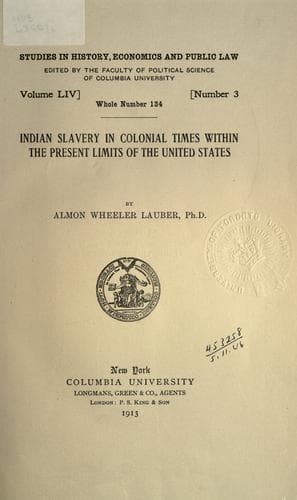
Indian slavery in colonial times within the present limits of the United StatesLauber, Almon Wheeler
History
Indian slavery in colonial times within the present limits of the United States
Lauber, Almon Wheeler
Indians of North America; Indians, Treatment of -- United States; Slavery -- United States; Thesis (Ph. D.)
In 1806, the Supreme Court of the state decided that Indians had
always been considered free persons in fact and in right, and that the
presumption was that all Indians introduced into the state at any time,
were _prima facie_ presumed to be free, or that, if the date of their
introduction did not appear, the _prima facie_ presumption was that
they were American Indians, or brought in after the act of 1705, and
therefore free.[1250] In 1808, came the judicial recognition of the
law of 1691. A Supreme Court decision of that year declared “that no
native American Indian brought into Virginia since the year 1691 could
under any circumstances lawfully be made a slave.” It was also held
by the court that if a female ancestor of a person asserting a right
to freedom, whose genealogy could be traced back to such ancestor by
females only, be proved to have been an Indian, “it seems incumbent on
those who claim such person as a slave to show that such ancestor, or
some female from which she descended, was brought into Virginia between
the years 1679 and 1691, and under circumstances which, according to
the laws then in force, created a right to hold her in slavery.”[1251]
In the case of Butt _v._ Rachel _et al._, 1814, the plaintiffs claimed
their freedom as descendants of a native female Indian who was brought
into Virginia about the year 1747. The court instructed the jury that
no native American Indian brought into Virginia since the year 1691,
could, under any circumstances, be made a slave. The defendant claimed
to hold the slaves on the ground that they were the descendants of a
native American Indian woman who was held as a slave on the island of
Jamaica, and brought to Virginia as a slave about the year 1747. The
defendant moved the court to instruct the jury that a native American
Indian held as a slave on the island of Jamaica by the laws of that
island, might be held as a slave when imported into Virginia. The court
refused so to do, and judgment was awarded the plaintiff. The case was
appealed, but the court sustained the judgment.[1252]
Considering the possibility already mentioned that the act of 1691 may
have been intended to apply only to Indians outside the colony and
that it did not apply to those in the colony, either free or enslaved,
and the fact that the later legislative action of 1777 and the cases
in law already mentioned show that the law was either misconstrued or
ignored, the acts of 1691 and 1705, so far as putting an end to Indian
slavery in Virginia in colonial times is concerned, might as well have
never existed.[1253]
Public-domain text, read in full here on John Shaqi.
Reviews
Reviews
No reviews yet
Be the first to share your thoughts on this work.
Elsewhere in the archive
Join the Discussion
Join the discussion
Sign in to leave a comment or review.
Sign InorCreate an account