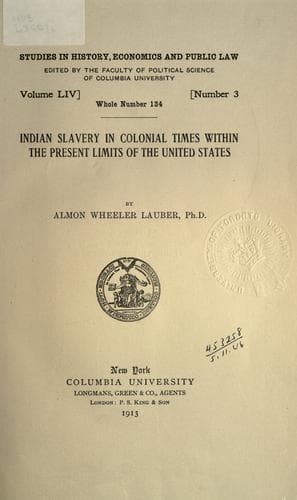
Indian slavery in colonial times within the present limits of the United StatesLauber, Almon Wheeler
History
Indian slavery in colonial times within the present limits of the United States
Lauber, Almon Wheeler
Indians of North America; Indians, Treatment of -- United States; Slavery -- United States; Thesis (Ph. D.)
In only a few of the English-American colonies were attempts made by
legislative enactment to end Indian slavery as a system separate from
negro slavery. The reasons for this fact are obvious. In the course of
time Indian slavery became absorbed by the institution of negro slavery
to such an extent that it attracted no attention. With the various
colonial acts at the time of the Tuscarora War, which forbade the
further importation of Indians into the northern colonies, the system
was maintained only by the natural increase of the Indian slaves
already in existence. So Indian slavery existed as an unimportant
system along with and overshadowed by negro slavery until the spirit of
opposition to the institution of slavery in general grew sufficiently
strong to lead to legislation providing for the abolition of slavery in
various colonies.
The first colony to take such legislative action was Virginia, but in
this instance there is a slight possibility that the intent of the act
to be discussed was quite different from what later interpretations
have considered it to be. In 1691, “by implication rather than by
the terms of the act”, Indian slavery was rendered illegal by an act
authorizing a free and open trade for all persons, at all times and
all places, with all Indians whatsoever.[1244] It is barely possible
that the “legislature may have viewed the act as a treaty with a
nation which, _ipso facto_, was recognized as of equal status as to
freedom, while the treaty in no wise prevented subsequent enslavement
of individuals sold by the nation itself to the whites, or of hostile
captives, or of Indians not native North Americans as generally
understood”.[1245] But it is generally considered that the act was
intended, as it was later construed, to acknowledge the free condition
of all Indians. If the colonists of the time so construed it, they
intentionally disobeyed it and enslavement of Indians continued. In
1705, a similar act was passed with the same enacting clause.[1246]
Cases arising later showed a similar failure to accomplish desired
results.
In 1777, the assembly, when called to pass upon the matter, decided
that no Indians brought into Virginia since the passage of the act of
1705, or their descendants, could be slaves in the commonwealth.[1247]
At that time knowledge of the existence of the act of 1691 seems to
have disappeared.[1248] Even after the decision of the assembly in
1777, the settlement of the matter was so far uncertain as to give rise
to certain cases in law in 1792 and 1793, appealed from the County
Court to the Court of Appeals to maintain the right to the services of
the descendants of Indians enslaved after the passing of the act of
1705. In both these cases the higher court affirmed the decision of the
lower courts which granted freedom to the Indians thus held as slaves,
and which interpreted the act of 1705 as repealing all former acts
permitting the existence of Indian slavery in the colony.[1249]
Public-domain text, read in full here on John Shaqi.
Reviews
Reviews
No reviews yet
Be the first to share your thoughts on this work.
Elsewhere in the archive
Join the Discussion
Join the discussion
Sign in to leave a comment or review.
Sign InorCreate an account