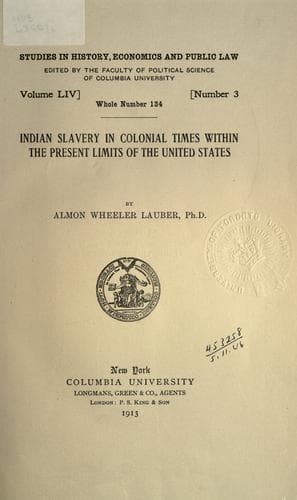
Indian slavery in colonial times within the present limits of the United StatesLauber, Almon Wheeler
History
Indian slavery in colonial times within the present limits of the United States
Lauber, Almon Wheeler
Indians of North America; Indians, Treatment of -- United States; Slavery -- United States; Thesis (Ph. D.)
The numerous petitions to the governor to free such Indians from
slavery, and his attitude in the matter, show the colonial authorities
willing to stand by their legislation on the subject. On December 28,
1700, such a petition was presented by the mayor and aldermen of New
York City to the governor, demanding the release of a free born Indian
woman, a native of Curaçao, then held as a slave in New York.[1264] On
July 15, 1703, Jacobus Kierstead, a mariner, of New York, petitioned
the governor regarding an Indian brought by him from the West Indies
and sold as a slave.[1265] Soon after Governor Hunter’s arrival in the
province a petition was handed him on behalf of a number of free-born
Spanish subjects thus held as slaves.[1266] Among the victims was one
Stephen Domingo, a native of Carthagena, who had been held as a slave
for eight years. Hunter became interested in the matter and wrote to
the Board of Trade, June 23, 1712, that there were Spanish Indians in
New York who had been unjustly kept there in slavery for many years. He
discovered that one Husea and one John, both held as slaves and both
engaged in the slave conspiracy of 1712, were brought to New York as
prisoners of war taken from a Spanish vessel by a privateer; that they
were Spanish-American Indians and subjects of the king of Spain, sold
as slaves in New York and kept in bondage six or seven years “by reason
of their color which is swarthy”. They declared they were sold among
many others of the same color and the same country. These two Indians
Governor Hunter reprieved awaiting the queen’s pleasure. The Indians
who petitioned, though he “secretly pitied their condition”, he was
unable to help as he had no other evidence than their words.[1267]
Rhode Island is the only other colony which took direct action
concerning Spanish Indians, but even Rhode Island never put forth any
general legislation on the matter. Special action was taken similar to
that in New York. In 1746, the general assembly of Rhode Island and
Providence Plantations voted to send back to the West Indies certain
free subjects of the king of Spain who had been captured and sold in
the colony as slaves.[1268] These, like the others mentioned, were
captives taken in the recent war with Spain.[1269] Here, as in New
York, the point involved was one of international importance, and the
Indians concerned were considered, not as Indians but as the objects
about which the point was raised.
The other colonies of the original thirteen which finally took
legislative action to end the institution of slavery in general did not
accomplish such action during the colonial period; so the conclusion
remains that with the exception of Virginia, South Carolina, Rhode
Island and New York, none of the colonies ever declared Indian slavery
illegal.
BIBLIOGRAPHY
TITLES MENTIONED IN THE TEXT
_Printed Material_
Public-domain text, read in full here on John Shaqi.
Reviews
Reviews
No reviews yet
Be the first to share your thoughts on this work.
Elsewhere in the archive
Join the Discussion
Join the discussion
Sign in to leave a comment or review.
Sign InorCreate an account