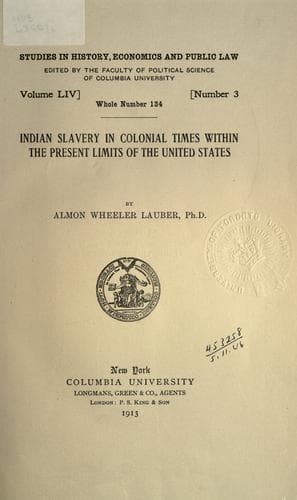
Indian slavery in colonial times within the present limits of the United StatesLauber, Almon Wheeler
History
Indian slavery in colonial times within the present limits of the United States
Lauber, Almon Wheeler
Indians of North America; Indians, Treatment of -- United States; Slavery -- United States; Thesis (Ph. D.)
[30] French, _op. cit._, pt. iii. p. 68.
[31] Bulletin 43 of the _Bureau of American Ethnology_, p. 296.
[32] _Publications of the Mississippi Historical Society_, v, p. 305.
[33] _Twenty-sixth Annual Report of the Bureau of American Ethnology_,
1904–1905, p. 197.
[34] _Bureau of American Ethnology Publications_, xiv, pt. i, p. 548.
[35] _Ibid._, p. 449; Lowery, _The Spanish Settlements within the
Present Limits of the United States, 1513–1561_, p. 314.
[36] French, _op. cit._, pt. iii, p. 74. Du Tisné meditated making
peace between the Pawnee and Padouca, and thought it could be done by
giving presents to each tribe, and by getting each to return the slaves
which it held of the other nation. Chappell, _op. cit._, p. 26.
[37] Iberville, in 1702, found them to number 2,000 men. Margry, _op.
cit._, iv, pp. 597–599.
[38] Thwaites, _Early Western Travels_, vi, p. 61; _Jesuit Relations_,
lxix, p. 301.
[39] Margry, _op. cit._, vi, p. 416.
[40] _Narrative of De Boucherville_, in _Wisconsin Historical Society
Collections_, xvii, pp. 42, 55, 89.
[41] _Michigan Pioneer and Historical Society Collections_, xxxiv, p.
182.
[42] Parkman, _A Half Century of Conflict_, ii, p. 46.
[43] The term “Pawnee” or “Panis” signifying an Indian slave was
especially used in Canada. See J. C. Hamilton, _Slavery in Canada_,
in _Transactions of the Canadian Institute_, 1890, pp. 102–108; “_The
Panis_” in _Canadian Institute Proceedings_, 1899, pp. 19–27; Smith,
_The Slave in Canada_, in _Nova Scotia Historical Society Reports_, x,
pp. 3, 72.
[44] Grignon, _Seventy-two Years’ Recollections of Wisconsin_, in
_Wisconsin Historical Society Collections_, iii, p. 256; Thwaites,
_Early Western Travels_, i, pp. 304, 309. In the present state of
Michigan, traces are found of Indians holding others as slaves, though
the Ordinance of 1787 forbade slavery in the Northwest Territory.
_Michigan Pioneer and Historical Society Collections_, xiv, p. 658.
[45] Hodge, _op. cit._, pt. ii, p. 598.
[46] _Ibid._, pt. ii, p. 598.
[47] _Ibid._, pt. ii, p. 598.
[48] Margry, _op. cit._, v, p. 506; French, _Historical Collections of
Louisiana_, pt. iii, pp. 33, 34, 68; Cramoisy, _Journal de la Guerre
du Micissippi contre les Chicachas_, pp. 65, 67, 68, 89; La Harpe,
_Historical Journal of the Establishment of the French in Louisiana_,
in French, _op. cit._, pt. iii, p. 27; Brickell, _op. cit._, p. 324.
[49] Douay, _Narrative of La Salle’s Expedition_, in Shea, _Discovery
and Exploration of the Mississippi Valley_, p. 204; French, _op. cit._,
pt. iv, p. 204.
[50] Shea, _op. cit._, pp. 205, 211, 216.
[51] French, _op. cit._, pt. i, p. 42.
[52] _Jesuit Relations_, xliii, p. 299; xliv, pp. 47, 49; l, p. 115.
[53] _Ibid._, xliii, p. 293.
[54] Hennepin’s _Narrative_, in Shea, _Discovery and Exploration of the
Mississippi Valley_, p. 144.
[55] _Jesuit Relations_, liv, pp. 93, 95.
Public-domain text, read in full here on John Shaqi.
Reviews
Reviews
No reviews yet
Be the first to share your thoughts on this work.
Elsewhere in the archive
Join the Discussion
Join the discussion
Sign in to leave a comment or review.
Sign InorCreate an account