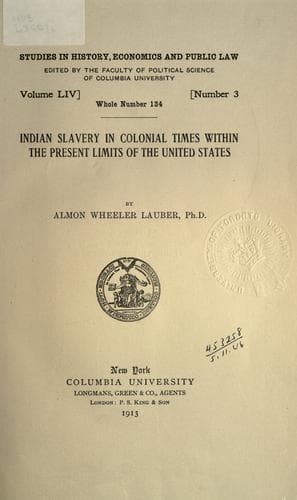
Indian slavery in colonial times within the present limits of the United StatesLauber, Almon Wheeler
History
Indian slavery in colonial times within the present limits of the United States
Lauber, Almon Wheeler
Indians of North America; Indians, Treatment of -- United States; Slavery -- United States; Thesis (Ph. D.)
The slaves of the Columbia River country were well treated as long as
they were able to work. The district was a commercial one, and the
slaves, as an article of commerce, were valuable. But when a slave grew
old and was unable to work, he was neglected. The women of the tribe
had several slaves who were dependent entirely upon their will. Slaves
could be purchased by the male members of the tribes for wives. The
Oackinacke Indians, at this time, possessed but few slaves, and these
were adopted as children and as members of the family. _Ibid._, vii,
pp. 103, 107, 303.
Until 1850, the Thompson Indians of British Columbia enslaved captive
Indians. Teit, _The Thompson Indians of British Columbia_, in _Memoirs
of the American Museum of Natural History_, pp. 269, 290. In 1836, the
Chinook Indians possessed Indian slaves. In 1855, the Ute sacrificed
four slaves, and buried them with one of their chiefs. One of these
slaves was buried alive. Thomas, _Indians of North America in Historic
Times_, p. 369. In 1863, the Cherokee abolished slavery by law. This
was amended in 1866, so as to permit it as a punishment for crime.
Thwaites, _Early Western Travels_, xx, p. 303.
[110] Enslavement of the whites by the Indians was not uncommon. Cabeza
de Vaca and other survivors of Narvaez’s expedition were made slaves by
the Indians among whom they wandered. _Narrative of Cabeza de Vaca_,
in _Narratives of Early American History_, i, pp. 64, 69. Soto found
one of these survivors, Juan Ortiz by name, who had taken on Indian
customs, and nearly forgotten his native language. “_Relation of
Biedma_,” in Bourne, _Narratives of the Career of De Soto_, ii, p. 3.
Strachey, _The Historie of Travaile into Virginia_, speaks of a story
that he had heard from the Indians, concerning an Indian chief, Eyanoco
by name, living somewhere to the south of Virginia, who had seven white
slaves who had escaped from the massacre at Roanoke. These slaves the
Indians employed in beating copper. _Hakluyt Society Publication_,
vi, p. 26. Whether the story is wholly or partly true has never been
determined. That the Indians of the locality did enslave the whites
captured in war or shipwrecked off the coast is shown by the preamble
of an act of Carolina in 1707. _North Carolina Colonial Records_,
i, p. 674. In the war of 1711, the Indians spared some of the women
and children captured on the plantations so that they might serve as
slaves. _Ibid._, i, p. 182.
Captain Hendrickson, in 1616, found three persons belonging to the
Dutch West India Company, who were slaves of the Mohawk and Minquae,
and who were traded to him for merchandise. Hazard, _Annals of
Pennsylvania_, p. 7.
Public-domain text, read in full here on John Shaqi.
Reviews
Reviews
No reviews yet
Be the first to share your thoughts on this work.
Elsewhere in the archive
Join the Discussion
Join the discussion
Sign in to leave a comment or review.
Sign InorCreate an account