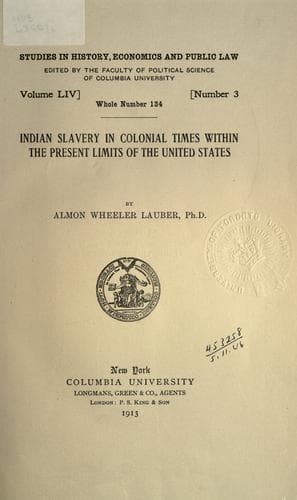
Indian slavery in colonial times within the present limits of the United StatesLauber, Almon Wheeler
History
Indian slavery in colonial times within the present limits of the United States
Lauber, Almon Wheeler
Indians of North America; Indians, Treatment of -- United States; Slavery -- United States; Thesis (Ph. D.)
[94] _Ibid._, xliii, p. 293.
[95] _Ibid._, 1, p. 115.
[96] Bartram, _op. cit._, p. 186.
[97] La Hontan, _op. cit._, ii, p. 613.
[98] Bartram, _op. cit._, p. 186.
[99] La Hontan, _op. cit._, ii, p. 474. These freed slaves were
accustomed to go each day to visit their former masters’ graves to
offer pipes and tobacco in acknowledgment of their freedom.
[100] Hodge, _op. cit._, pt. ii, p. 598.
[101] _Ibid._, pt. ii, p. 599.
[102] _Ibid._ For the Iroquois, see Carr, _op. cit._, p. 18; Margry,
_op. cit._, v, p. 8; _Jesuit Relations_, lxii, p. 63. For the western
Indians, see Hennepin, _op. cit._, p. 509; _Jesuit Relations_, lxix,
p. 59. For the northern Indians, see Catesby, _op. cit._, ii. p. xiii
(editor’s note).
[103] Hennepin, _op. cit._, ii, p. 508.
[104] _Fifteenth Annual Report of the Bureau of American Ethnology_,
1893–1894, p. cxii.
[105] Brickell, _op. cit._, p. 321; Lawson, _op. cit._, p. 323;
Catesby, _op. cit._, ii, p. xiii.
[106] _Jesuit Relations_, liv, p. 237.
[107] La Hontan, _op. cit._, ii, p. 508.
[108] _Wisconsin Historical Society Collections_, xvi, p. 46.
[109] The holding of slaves by the Indians continued long after
colonial times. It naturally died out first in the east, with the
growth in power of the whites and the consequent decrease in the
numbers and strength of the Indians.
The Indians of the Columbia River country held slaves till well into
the nineteenth century. These they procured by trading beads and
furs with the interior tribes. Franchère’s _Narrative_, in Thwaites,
_Early Western Travels_, vi, p. 324; xxix, p. 242; xxx, p. 111. The
Blackfeet, Cayuse, Crows, and Ute were accustomed to keep the women
taken in war as slaves, (_Ibid._, xxiii, p. 118); and other neighboring
tribes did the same. Travelers in Oregon in 1846 found that the Oregon
Indians enslaved their war captives, and that they made war for the
purpose of obtaining slaves. _Ibid._, xxix, p. 124. The Toungletat,
who inhabited Vancouver Island, at the same time had Indian slaves,
captives in war. _Ibid._, xxix, p. 149. The tribes of the section south
of the Columbia River country were given over to the same custom.
Both here, and in the Columbia River country, the Indians were heavy
gamblers, and not infrequently staked their own freedom in their games.
_Ibid._, xxx, p. 161; xxvii, p. 171; Parker, _Journey Beyond the Rocky
Mountains_, p. 53. The Indians of the extreme northwest held slaves in
1840. Considerable numbers were owned by the chiefs. These were worth
thirty blankets each, and were generally purchased from the natives of
Queen Charlotte Island, the great slave mart of the northwest coast.
Bancroft, _History of the Northwest Coast_, ii, pp. 647–649.
Public-domain text, read in full here on John Shaqi.
Reviews
Reviews
No reviews yet
Be the first to share your thoughts on this work.
Elsewhere in the archive
Join the Discussion
Join the discussion
Sign in to leave a comment or review.
Sign InorCreate an account