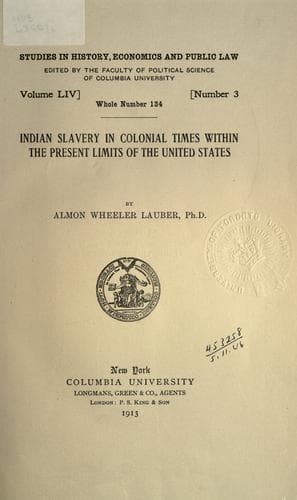
Indian slavery in colonial times within the present limits of the United StatesLauber, Almon Wheeler
History
Indian slavery in colonial times within the present limits of the United States
Lauber, Almon Wheeler
Indians of North America; Indians, Treatment of -- United States; Slavery -- United States; Thesis (Ph. D.)
[118] The proclamation of Ponce de Leon is quoted in Helps, _The
Conquerors of the New World and Their Bondsmen_, etc., ii, pp. 111–116.
This peculiar summons to surrender had been used by the Spanish
explorers and conquerors since 1509. After telling the Indians of the
creation of the world, it traced the title thereto to St. Peter, and
thence to the ruling pope. It cited also the grant of the Indies by
the pope to the sovereigns of Castile; and after urging the Indians to
acknowledge their fealty to these sovereigns, it threatened them with
war and slavery if they refused.
[119] Lowery, _op. cit._, p. 169.
[120] _The Narrative of Cabeza de Vaca_, in _Original Narratives of
Early American History_, ii, p. 25.
[121] _Ibid._, ii, p. 30.
[122] Bourne, _op. cit._, i, p. 20.
[123] Buckingham Smith, _Life of De Soto_, p. 170.
[124] Bourne, _op. cit._, ii, pp. 60, 94, 97, 103, 105.
[125] Bourne, _op. cit._, i, p. 34.
[126] _Ibid._, i, p. 45; ii, pp. 25, 121.
[127] _Ibid._, i, p. 70; ii, pp. 72, 75, 117, 129.
[128] Coronado, in his letter to Mendoza, August 3, 1540, mentions
both negroes and Indians in the expedition. He does not allude to
their being slaves. In other parts of the letter, he mentions friendly
Indians accompanying the expedition. _Coronado’s Letter to Mendoza_,
in the _Fourteenth Annual Report of the Bureau of American Ethnology_;
Shea, _The Catholic Church in Colonial Days_, p. 114.
[129] _The Narrative of the Expedition of Coronado_, by Pedro de
Castañeda, in _Original Narratives of Early American History_, ii, p.
324.
[130] Lowery, _op. cit._, pp. 156–157; Martin, _The History of North
Carolina from the Earliest Period_, i, p. 2.
[131] _The Narrative of Cabeza de Vaca_ in _Original Narratives of
Early American History_, i, pp. 25–118. Among the Indians of this
region, who were carried away into captivity, were Yaqui who long
afterwards remained hostile to the whites.
[132] Bancroft, _History of the North Mexican States_, i, p. 59.
[133] French, _op. cit._, pt. iv, p. 201; Shea, _Discovery and
Exploration of the Mississippi Valley_, p. 201.
[134] For such instances in Soto’s journey, see Bourne, _op. cit._
For Coronado’s journey, see _Original Narratives of Early American
History_, ii, pp. 289, 329, 342; _Narrative of Jaramillo_, in
_Fourteenth Annual Report of the Bureau of American Ethnology_.
[135] Bourne, _op. cit._, ii, p. 11.
[136] _Ibid._, i, p. 20.
[137] _Ibid._, ii, p. 55.
[138] _The Narrative of the Expedition of Coronado_, by Castañeda, in
_Original Narratives of Early American History_, ii, pp. 329, 342.
[139] Bourne, _op. cit._, ii, pp. 21, 117.
[140] _Ibid._, i, p. 45; ii, pp. 25, 121.
[141] _The Narrative of the Expedition of Coronado_, by Castañeda, in
_Original Narratives of Early American History_, ii, p. 289.
[142] Bourne, _op. cit._, i, pp. 193–194.
[143] Fairbanks, _History of Florida from Its Discovery_, etc., p. 58.
Public-domain text, read in full here on John Shaqi.
Reviews
Reviews
No reviews yet
Be the first to share your thoughts on this work.
Elsewhere in the archive
Join the Discussion
Join the discussion
Sign in to leave a comment or review.
Sign InorCreate an account