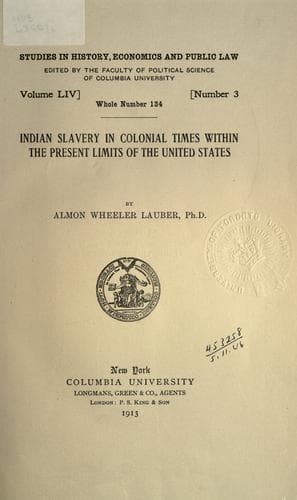
Indian slavery in colonial times within the present limits of the United StatesLauber, Almon Wheeler
History
Indian slavery in colonial times within the present limits of the United States
Lauber, Almon Wheeler
Indians of North America; Indians, Treatment of -- United States; Slavery -- United States; Thesis (Ph. D.)
[144] Lowery, _The Spanish Settlements within the Present Limits of the
United States, 1513–1561_, pp. 249 (note), 357, 415, 417.
[145] _The Narrative of the Expedition of Coronado_, by Castañeda, in
_Original Narratives of Early American History_, ii, p. 324.
[146] Bourne, _op. cit._, i, p. 177; ii, p. 60.
[147] _Ibid._, i, pp. 102, 139, 171, 191; ii, pp. 80, 121.
[148] _Ibid._, i, pp. 44, 84, 93; ii, pp. 94, 97, 103, 105, 106, 110,
112, 113, 115, 116, 117.
[149] See Lucas and Stevens, _The New Laws of the Indies_.
[150] Houck, _History of Missouri_, ii, p. 240; Wheeler, _A Practical
Treatise of the Law of Slavery_, pp. 12–14. O’Reilly’s instructions to
the various commandants at Natchitoches, the coast and elsewhere, are
given in Gayarré, _History of Louisiana, Spanish Domination_, pp. 20,
25.
[151] Bancroft, _History of Arizona and New Mexico, 1530–1888_, p. 132.
[152] Lowery, _The Spanish Settlements within the Present Limits of the
United States, Florida, 1562–1574_, pp. 145–160.
[153] Hodge, _op. cit._, pt. i, p. 874.
[154] Hodge, _op. cit._, pt. i, p. 893.
[155] _Ibid._, pt. i, pp. 894–895.
[156] _Ibid._, pt. i, p. 895; Bancroft, _History of California_, i,
p. 111; Coman, _Economic Beginnings of the Far West_, i, pp. 100–101,
147–155.
[157] Hodge, _op. cit._, pt. i, p. 894.
[158] Coman, _op. cit._, ii, pp. 28–29, 31–32, 144.
[159] _Ibid._, i, pp. 40–44.
[160] _Ibid._, i, p. 99.
[161] Barrett, _The Ethno-Geography of the Pomo and Neighboring
Indians_, in _University of California Publications in American
Archaeology and Ethnology_, vi, p. 45.
[162] The edict of Louis XIV in 1688 authorizing the importation of
slaves related only to negroes from Africa. Hamilton, _Slavery in
Canada_, in _Transactions of the Canadian Institute_, 1890, i, p. 102.
[163] Hamilton, _op. cit._, in _Transactions of the Canadian
Institute_, 1890, i, p. 102; _Mémoires et Documents Relatifs à
l’Histoire du Canada_, p. 5.
[164] Margry, _op. cit._, vi, p. 316.
[165] Hamilton, _op. cit._, in _Transactions of the Canadian
Institute_, 1890, i, p. 102.
[166] Hamilton, _op. cit._, in _Transactions of the Canadian
Institute_, 1890, i, p. 102; _New York Colonial Documents_, x, p. 1118.
General Amherst, the English commander and agent in the negotiations,
wrote opposite the proposition: “Granted, except those who shall have
been made prisoners.”
Though the word “Pawnee,” in the records, seems to have special
reference to Indian slaves, it is sometimes used by the old Canadian
writers to signify all persons in servitude, without regard to color.
Hamilton, _op. cit._, in _Transactions of the Canadian Institute_,
1890, i, p. 107.
[167] In 1557, ten young Brazilian Indians were purchased by
Villegaignon, and sent to France as a gift to King Henry II. The king
distributed them among the nobles of his court. Lescarbot, _Histoire de
la Nouvelle-France_, i, p. 174.
[168] See _Transactions of the Canadian Institute_, ii, p. 173.
Public-domain text, read in full here on John Shaqi.
Reviews
Reviews
No reviews yet
Be the first to share your thoughts on this work.
Elsewhere in the archive
Join the Discussion
Join the discussion
Sign in to leave a comment or review.
Sign InorCreate an account