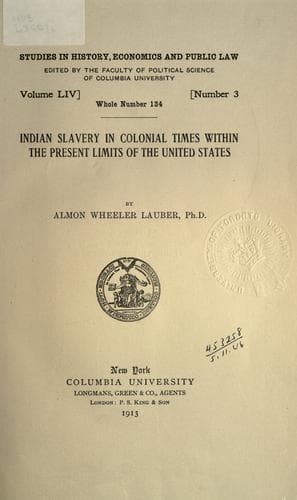
Indian slavery in colonial times within the present limits of the United StatesLauber, Almon Wheeler
History
Indian slavery in colonial times within the present limits of the United States
Lauber, Almon Wheeler
Indians of North America; Indians, Treatment of -- United States; Slavery -- United States; Thesis (Ph. D.)
[195] _Michigan Pioneer and Historical Society Collections_, xxxiii, p.
286.
[196] _Ibid._, pp. 324, 397.
[197] _Ibid._, pp. 328, 439, 544.
[198] _Ibid._, p. 550.
[199] _Ibid._, pp. 365, 396.
[200] _Wisconsin Historical Society Collections_, xvi, pp. 434, 436.
[201] Bossu, _Nouveaux Voyages dans l’Amérique Septentrionale_, p. 100.
[202] _Wisconsin Historical Society Collections_, xvi, p. 343.
[203] Kohl, _Documentary History of Maine_, i, p. 255. Verrazano says
of the Indians of this region: “They are suspicious, hostile and
desirous of obtaining steel implements for defense against kidnappers,
who frequent the coast to seize and transport them to the Spanish
Islands of the West Indies.”
[204] Hakluyt, _Voyages_, iii, pp. 209, 213; Lescarbot, _Histoire de
la Nouvelle-France_, ii, p. 350; Kohl, _Documentary History of Maine_,
i, pp. 327, 330; Douglas, _Old France in the New World_, pp. 22, 23,
27, 28, 30; Robinson, _An Account of Discoveries_, etc., p. 359. _Early
English and French Voyages, chiefly from Hakluyt_, 1534–1608, in
_Original Narratives of Early American History_, p. 81.
[205] Lescarbot, _Histoire de la Nouvelle-France_, ii, p. 364; Douglas,
_op. cit._, pp. 39, 40, 42.
[206] Lescarbot, _op. cit._, ii, pp. 363–367; Kohl, _Documentary
History of Maine_, i, p. 336; Douglas, _op. cit._, p. 37; Robinson,
_op cit._, p. 369. _Early English and French Voyages, chiefly from
Hakluyt_, 1534–1608, in _Original Narratives of Early American
History_, p. 81. The promise of Cartier that the prisoners should be
well treated was evidently kept. In the archives of St. Malo for the
year 1538, is noted the baptism of three savages brought there by
Cartier. Winsor, _Narrative and Critical History of America_, iv, p.
57. These Indians were questioned by Francis I, (Thevet, _Cosmographie
Universelle_, Tome II, p. 1013), and thus served the purpose for which
they had been brought. They never returned to America, for all of them,
except one little girl, died in Brittany before Cartier’s third voyage
in 1540. Kohl, _Documentary History of Maine_, i, p. 342; Robinson,
_op. cit._, p. 406.
[207] Hakluyt, _op. cit._, iii, pp. 303–319; Lescarbot, _op. cit._, i,
p. 44; _Narrative of Jean Ribaut’s Whole and True Discovery of Terra
Florida_, reprinted in Courtnay, _The Genesis of South Carolina_, p.
xxiv.
[208] Hakluyt, _op. cit._, iii, p. 320, says, “by permission of the
king”; Robinson, _op. cit._, p. 431.
[209] French, _op. cit._, p. 74; Margry, _op. cit._, vi, pp. 282, 370,
371. An instance of kidnapping Indians in Canada by military officials
is worthy of mention. In 1687, a number of Iroquois chiefs went to a
French camp near Montreal, on the invitation of the French officials,
to confer with the governor of Canada. The intendant, Champigny, had
these chiefs seized and by the king’s orders sent to France to serve in
the galleys. Brodhead, _History of New York_, first edition, ii, p. 476.
[210] Margry, _op. cit._, vi, p. 314.
Public-domain text, read in full here on John Shaqi.
Reviews
Reviews
No reviews yet
Be the first to share your thoughts on this work.
Elsewhere in the archive
Join the Discussion
Join the discussion
Sign in to leave a comment or review.
Sign InorCreate an account