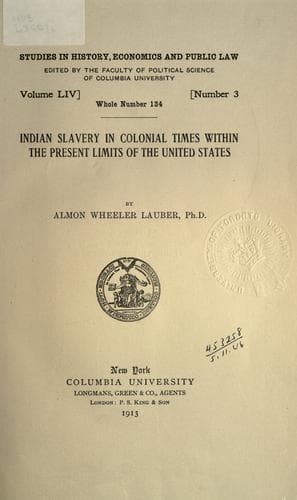
Indian slavery in colonial times within the present limits of the United StatesLauber, Almon Wheeler
History
Indian slavery in colonial times within the present limits of the United States
Lauber, Almon Wheeler
Indians of North America; Indians, Treatment of -- United States; Slavery -- United States; Thesis (Ph. D.)
[169] Parkman, _The Discovery of the Great West_, sixth edition, p. 27.
[170] Thwaites, _Father Marquette_, p. 34.
[171] It should be noted that the missions never attained the same
prominence among the French, within the limits of the present United
States, as among the Spaniards. “The neophyte was too much a child, too
much a slave, too little a man” to please the Frenchman.
[172] Margry, _op. cit._, v, p. 162. La Salle, on his expedition,
employed Indian hunters who were not slaves. Joutel’s _Journal of La
Salle’s Last Voyage_, pp. 20, 76, 82, 94, 95, 97, 98; Parkman, _The
Discovery of the Great West_, sixth edition, pp. 144, 356.
[173] _Jesuit Relations_, xxx, p. 133.
[174] _Archives du Ministre des Colonies, C. 13 ... Correspondance
Générale_, ii, 1707–1712.
[175] Lowry and McCardle, _A History of Mississippi from the
Discovery_, etc., second edition, p. 84.
[176] Thwaites, _Early Western Travels_, xiii, p. 179.
[177] Thomas, _The Indians of North America_, etc., p. 321.
[178] Garneau, _Histoire du Canada_, etc., fourth edition, ii, p. 95.
“The number of the Natchez that escaped the grasp of Périer, at this
time, has been put down by some writers as three hundred warriors.”
French, _Historical Memoirs of Louisiana_, series 5, p. 102.
[179] Hodge, _op. cit._, pt. ii, p. 36; Monette, _History of the
Discovery and Settlement of the Valley of the Mississippi_, etc., i,
p. 272, states the number as four hundred and twenty-seven. Lowry
and McCardle, _op. cit._, p. 85, place the number as forty-five male
Indians, and four hundred and fifty women and children.
[180] Pittman, _The Present State of the European Settlements on the
Mississippi_, Hodder edition, p. 80.
[181] On the passage, some of the Indians, for “showing their
resentment by upbraiding the authors of their misery,” were thrown into
the sea. _Ibid._, p. 80.
[182] Marbois, _op. cit._, p. 119, and appendix, No. 4.
[183] Ferland, _Cours d’Histoire du Canada_, seconde partie, p. 446.
[184] Landun, _Journal d’un Voyage à la Louisiane fait en 1720_, p.
247; Margry, _op. cit._, vi, p. 316; La Harpe’s _Journal_ in French,
_op. cit._, p. 351.
[185] Martin, _The History of Louisiana from the Earliest Period_, i,
p. 256.
[186] _Ibid._, i, p. 256.
[187] Dubroca, _L’Itinéraire des Français dans la Louisiane_, p. 81.
[188] Thomas, _The Indians of North America_, etc., p. 319; Cramoisy,
_Journal de la Guerre du Micissippi contre les Chicachas_, p. 65.
[189] Cramoisy, _op. cit._, p. 65.
[190] Gayarré, _Louisiana, its History as a French Colony_, p. 64.
[191] Cramoisy, _op. cit._, pp. 49, 65, 67, 68, 89; Margry, _op. cit._,
v, p. 432.
[192] Margry, _op. cit._, iii, p. 564.
[193] French, _op. cit._, pt. i, p. 42.
[194] Margry, _op. cit._, v, p. 476; French, _op. cit._, new series, i.
p. 100. Hennepin, _A New Discovery_, etc., p. 631, mentions the French
of Kaskaskia using both Indian and negro slaves.
Public-domain text, read in full here on John Shaqi.
Reviews
Reviews
No reviews yet
Be the first to share your thoughts on this work.
Elsewhere in the archive
Join the Discussion
Join the discussion
Sign in to leave a comment or review.
Sign InorCreate an account