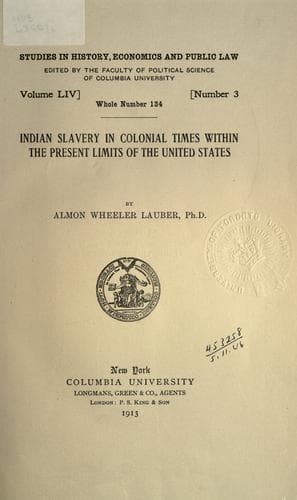
Indian slavery in colonial times within the present limits of the United StatesLauber, Almon Wheeler
History
Indian slavery in colonial times within the present limits of the United States
Lauber, Almon Wheeler
Indians of North America; Indians, Treatment of -- United States; Slavery -- United States; Thesis (Ph. D.)
[266] Pittman, _The Present State of the European Settlements on
the Mississippi_, etc., Hodder edition, p. 102; Hamilton, _Colonial
Mobile_, p. 67; Monette, _History of the Discovery and Settlement
of the Valley of the Mississippi_, i, p. 192; Gayarré, _History of
Louisiana, French Domination_, i, p. 242; Thwaites, _Early Western
Travels_, xxvii, p. 55; _Jesuit Relations_, lxix, p. 145; Martin,
_History of Louisiana_, i. p. 173.
[267] Guénin, _La Louisiane_, p. 297.
[268] Pittman, _op. cit._, Hodder edition, p. 102.
[269] _Jesuit Relations_, lxix, p. 145.
[270] _Wisconsin Historical Society Collections_, xvi, p. 332.
[271] _Mississippi Provincial Archives, French Domination,
Correspondance Générale_, iv, 1713–1714, p. 14; _Notes et Documents
Historiques de la Louisiane_, p. 29.
[272] Bossu, _op. cit._, p. 114; Margry, _op. cit._, i, p. 112.
[273] _Wisconsin Historical Society Collections_, xvi, pp. 378, 379,
454.
[274] Margry. _op. cit._, ii, p. 293. The only instance in which a
home government demanded that Indians be sent to Europe to perform
actual labor as slaves, exists in the case of the French. On July 31,
1684, Louis XIV ordered de la Barre to send all Iroquois prisoners
to France to serve in the galleys, because, said the letters royal,
“these savages are strong and robust.” Brodhead, _History of New York_,
first edition, ii, p. 476. De la Barre made an expedition against the
Iroquois, but was unsuccessful. In 1687, Denonville, the succeeding
governor-general, led another expedition against the Iroquois who had
been especially arrogant toward the French since the repulse of de la
Barre. Before the expedition had set out from Fort Frontenac, another
dispatch from the king had arrived. This repeated his former orders
to send the Iroquois prisoners to France to serve in the galleys.
Denonville obeyed the command. Brodhead, _op. cit._, ii, p. 507. The
order was repeated March, 1688, declaring “It is certain that those
Indians, who are vigorous and accustomed to hardship, can serve
usefully on board his Majesty’s galleys,” Brodhead, _op. cit._, ii,
p. 546. Continued difficulties with the Indians led Denonville, among
other concessions and attempts at conciliation, to write to France,
asking that as many of the Indian galley slaves as survived should be
returned to Canada, and suggesting that, to produce as good an effect
as possible, they be decently clothed. The request was complied with.
Marshall, _Historical Writings relating to the early History of the
West_, p. 159; De Brumath, _Bishop Laval_, pp. 214, 215, 216. For a
description of the French galleys of the time, see Clément, _Vie de
Colbert_, p. 456.
[275] Parkman, _A Half-Century of Conflict_, ii, p. 17.
[276] Margry, _op. cit._, vi, p. 402.
[277] _Arkansas Historical Society Publications_, ii, p. 342.
[278] Hamilton, _Slavery in Canada_, in _Transactions of the Canadian
Institute_, 1890, i, p. 103.
Public-domain text, read in full here on John Shaqi.
Reviews
Reviews
No reviews yet
Be the first to share your thoughts on this work.
Elsewhere in the archive
Join the Discussion
Join the discussion
Sign in to leave a comment or review.
Sign InorCreate an account