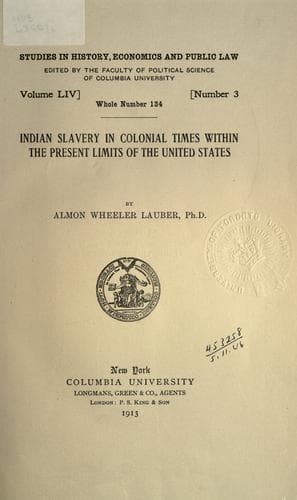
Indian slavery in colonial times within the present limits of the United StatesLauber, Almon Wheeler
History
Indian slavery in colonial times within the present limits of the United States
Lauber, Almon Wheeler
Indians of North America; Indians, Treatment of -- United States; Slavery -- United States; Thesis (Ph. D.)
[356] Glenn, _A Description of South Carolina_, etc., p. 81;
_Charleston Year Book_, 1883, p. 407. (A quotation from a pamphlet
entitled, “The Importance of the British Plantations in America to this
Kingdom,” London, 1731).
[357] Dalcho, _An Historical Account of the Protestant Episcopal Church
in South Carolina_, p. 287; Humphreys, _An Historical Account of the
Incorporated Society for the Propagation of the Gospel in Foreign
Parts_, etc., edition of 1730, pp. 103–105.
As the result of the intermingling of negroes and Indians, which came
about when the coast tribes dwindled and the small number of remaining
members moved inland, associated and intermarried with the negroes
until they finally lost their identity and were classed with that
race, a considerable portion of the blood of the southern negroes is
unquestionably Indian. _Nineteenth Annual Report of the Bureau of
American Ethnology_, 1897–1898, p. 233. It was these mixed bloods, as
well as the pure blood Indians, to which the statutes referred by the
terms “Indian slaves” and “mustee,” or “mestee,” slaves. Occasional
mention is made in the colonial newspapers of slaves of the mixed
red and black races. _American Weekly Mercury_, October 24, 1734.
The opinion has even been advanced that, in certain of the colonies,
there never were any pure blood Indian slaves. Mr. W. B. Melius of
Albany, New York, asserts; “I do not believe the pure Indian was sold
as a slave (in New York), I believe the Indian who was the slave was
not without mixture.” _New York State Library Bulletin, History_, No.
4, May, 1900. One instance of the mixture of the Indians and negroes
in New York is found in a complaint made in 1717, that negro slaves
ran away, and were secreted by the Minisink with whose women they
intermarried. _Ibid._, No. 4, May, 1900.
[358] _Colonial Records of the State of Georgia_, vi, p. 259, mentions
an Indian slave in 1749.
[359] Howe, _Historical Collections of Virginia_, etc., p. 134.
[360] Winthrop, _Journal History of New England_, i, p. 225, in
_Original Narratives of Early American History_.
[361] See Chapter V.
[362] “It seems probable that there were no Indian slaves in Plymouth
before the division of land in 1623.” _Massachusetts Historical Society
Collections_, series 4, iii, p. 114.
[363] _Boston News Letter_ and other newspapers.
[364] Ellis, _The History of Roxbury Town_, p. 136.
[365] Felt, _The History of Ipswich_, pp. 306, 320; _Boston Weekly
Mercury_, October 2, 1735.
[366] Wilson, _Where American Independence Began_, p. 154.
[367] Corey, _The History of Malden_, p. 416.
[368] _Ibid._
[369] Chase, _The History of Haverhill_, pp. 239, 248.
[370] Earle, _Customs and Fashions in Old New England_, p. 84.
Public-domain text, read in full here on John Shaqi.
Reviews
Reviews
No reviews yet
Be the first to share your thoughts on this work.
Elsewhere in the archive
Join the Discussion
Join the discussion
Sign in to leave a comment or review.
Sign InorCreate an account