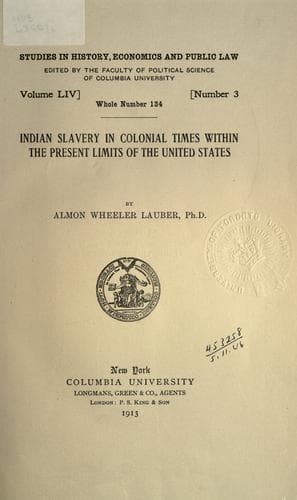
Indian slavery in colonial times within the present limits of the United StatesLauber, Almon Wheeler
History
Indian slavery in colonial times within the present limits of the United States
Lauber, Almon Wheeler
Indians of North America; Indians, Treatment of -- United States; Slavery -- United States; Thesis (Ph. D.)
[371] Doyle, _English Colonies in America, The Puritan Colonies_,
ii, p. 68. In 1708, Governor Dudley made a report on slaves and the
slave trade to the Board of Trade, in which he stated that there were
400 negro slaves in Massachusetts. No mention was made of Indians.
_Historical Magazine_, x, p. 52.
[372] _American Antiquarian Society Proceedings_, 1885–1887, new
series, iv, p. 216.
[373] _American Statistical Association Collections_, i, pp. 208–214;
_Massachusetts Historical Society Collections_, series 1, iv, p. 199.
[374] Livermore, _A History of Block Island_, etc., p. 60.
[375] _New England Courant_, June 17, 1723—A Spanish Indian runaway
from Newport; _Boston Gazette_, October 28, 1728—An Indian runaway
slave from Warwick, Rhode Island.
[376] Channing, _The Narragansett Planters_, p. 10, in _Johns Hopkins
University Studies_, iv.
[377] _Ibid._, p. 10.
[378] _Colonial Records of Rhode Island and Providence Plantations_,
viii, p. 359.
[379] Bradford, _History of Plymouth Plantation_, p. 342, in _Original
Narratives of Early American History_.
[380] See pp. 130–131, 150.
[381] Caulkins, _History of New London_, pp. 330, 335, mentions Indian
slaves in 1711 and 1735; An Indian woman slave lived in Westbury until
her death in 1774. Steiner, _History of Slavery in Connecticut_, p. 21,
in _Johns Hopkins University Studies_, xi.
[382] Steiner, _op. cit._, p. 12, in _Johns Hopkins University
Studies_, xi.
[383] Sanborn, _New Hampshire, an Epitome of Popular Government_, p.
137.
[384] Sanborn, _op. cit._, p. 151, states that in 1720, hardly an
Indian remained in New Hampshire, except, perhaps, an enslaved captive.
[385] The _Boston Postboy_, May 2, 1743, advertises a runaway Indian
slave from Portsmouth, New Hampshire. The same paper, July 25, 1743,
advertises another runaway Indian slave from New Castle, in the same
colony.
[386] “In theory, at least, the Hollander considered the Indian a man
like himself, with analogous rights to life, liberty and possessions.”
Consequently, “Indians were not enslaved in New Netherland.” Van
Rensselaer, _History of the City of New York in the Seventeenth
Century_, i, p. 63. These statements are rather difficult to prove.
Holding Indians as slaves who had been enslaved elsewhere and then
brought into the colony, and making slaves in the colony and then
sending them out of it, were practices that unquestionably existed,
even if on a small scale. The declaration of the governor and council
of New York in 1680 that “all Indians here have always been, and are,
free, and not slave, except such as have been formerly brought from the
Bay and Foreign Ports,” (Brodhead, _History of the State of New York_,
first edition, ii, p. 331), shows the presence of some Indian slaves in
the Dutch colony.
Public-domain text, read in full here on John Shaqi.
Reviews
Reviews
No reviews yet
Be the first to share your thoughts on this work.
Elsewhere in the archive
Join the Discussion
Join the discussion
Sign in to leave a comment or review.
Sign InorCreate an account