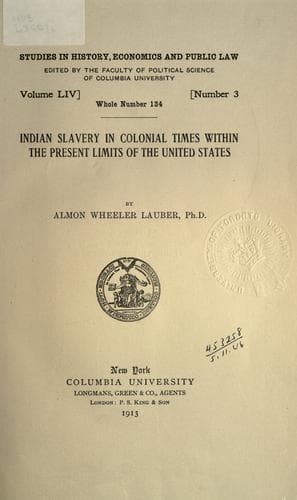
Indian slavery in colonial times within the present limits of the United StatesLauber, Almon Wheeler
History
Indian slavery in colonial times within the present limits of the United States
Lauber, Almon Wheeler
Indians of North America; Indians, Treatment of -- United States; Slavery -- United States; Thesis (Ph. D.)
[407] Cornelius Van Vorst had a slave known as “Half Indian Jack,” who
died at Harsimus, February 2, 1831, at the age of 102 years. Winfield,
_History of the County of Hudson, New Jersey_, p. 434.
_The New York Gazette_, June 24, July 8, July 15, July 29, August 12,
and August 26, advertises a runaway Indian slave, and a second slave,
half Indian and half negro, from Monmouth County, New Jersey. _The
American Weekly Mercury_, October 24, October 31, and November 7, 1734,
advertises a runaway slave, half Indian and half negro, from Perth
Amboy, New Jersey.
[408] The Yoamaco Indians of that section had been so preyed upon by
the “Susquahannocks” that they had abandoned their country. Oldmixon,
_The British Empire in America_, etc., i, p. 189.
[409] Lawson, _A New Voyage to Carolina_, etc., p. 194, states that the
Indians of the Carolina country refused to sell their children, though
they would sell anything else they possessed for wampum. For precedents
when the English sold white captives in war, see Trowbridge, _A History
of Ancient Maritime Interests in New Haven_, p. 47; Lecky, _A History
of England in the Eighteenth Century_, ii, p. 189.
[410] Quoted in Bannister, _British Colonization and Colored Tribes_,
pp. 49–54.
[411] _William and Mary College Quarterly_, vi, p. 214.
[412] _The Narrative of Bacon’s Rebellion_, in Winder Papers, Virginia
State Library, reprinted in _Virginia Magazine of History_, iv,
1896–1897, p. 140, tells of forty-five Indian captives taken. “The
plunder and captives estimated noe lesse than 6 or 700, the goodes
being three horse loades.”
[413] _Calendar of State Papers_, colonial series, x, p. 165. Later all
but five were restored to the queen by Ingram, one of Bacon’s officers.
[414] Rivers, _A Sketch of the History of South Carolina_, etc., p. 106.
[415] Hewat, _op. cit._, i, p. 78; Grahame, _The History of the United
States_, etc., ii, p. 113.
[416] Rivers, _op. cit._, p. 200.
[417] Religious hatred and race hatred, as well as the desire for
personal gain, dictated Moore’s action. Note that the constant enmity
of the Spanish and English Indians, and their raids upon each other,
gave him excellent opportunity to accomplish his purpose.
[418] Hewat, _op. cit._, i, p. 157.
[419] _Nineteenth Annual Report of the Bureau of American Ethnology_,
p. 233.
[420] _Public Records of South Carolina_, v, 1700–1710, p. 196;
_British Public Record Office_, vol. 620.
[421] Fairbanks, _History of Florida from its Discovery_, etc., p. 179.
[422] Fairbanks, _op. cit._, p. 189; Fairbanks, _The History and
Antiquities of the City of St. Augustine_, etc., p. 139.
[423] Hodge, _op. cit._, pt. i, p. 875; pt. ii, p. 600.
[424] _Records of the Society for the Propagation of the Gospel in
Foreign Parts._
[425] A few Indians were captured before this, and a few more were
imported, like other slaves. Bassett, _Slavery and Servitude in
the Colony of North Carolina_, p. 72, in _Johns Hopkins University
Studies_, xiv.
Public-domain text, read in full here on John Shaqi.
Reviews
Reviews
No reviews yet
Be the first to share your thoughts on this work.
Elsewhere in the archive
Join the Discussion
Join the discussion
Sign in to leave a comment or review.
Sign InorCreate an account