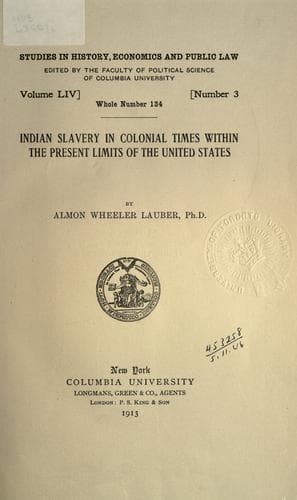
Indian slavery in colonial times within the present limits of the United StatesLauber, Almon Wheeler
History
Indian slavery in colonial times within the present limits of the United States
Lauber, Almon Wheeler
Indians of North America; Indians, Treatment of -- United States; Slavery -- United States; Thesis (Ph. D.)
[461] Drake’s Note in Hubbard, _op. cit._, ii, p. 94. These Indians did
not sell well abroad, for doubtless former experience had proved their
race to be unsatisfactory as slaves. In one instance, when no immediate
market could be found, a number of them were left in the slave market
of Algiers from which, by the efforts of John Eliot, they were enabled
to return to America in 1683. _Massachusetts Historical Society
Collections_, series 1, ii, p. 183. Of this incident Cotton Mather
said: “Moreover, ’tis a prophecy in Deut. 28: 68, ‘The Lord shall bring
thee into Egypt again with ships, by the way whereof I spake unto thee.
Thou shalt see it no more again; and there ye shall be sold unto your
enemies for bondmen and bondwomen, and no man shall buy you.’ These did
our Eliot imagine were sent to be sold in the coasts lying not very
far from the coasts of Egypt, on the Mediterranean Sea, and scarce any
chapman would offer to take them off.” _Magnalia_, bk. iii, pt. 3.
[462] Baylies, _op. cit._, ii, pt. iii, p. 190.
[463] For a discussion of the treatment of Philip’s wife and son, see
_Massachusetts Historical Society Collections_, series 4, viii, p. 689.
For the opinions of the two eminent divines to whom the matter of their
disposal was referred before colonial action was taken, see Baylies,
_op. cit._, ii, pt. iii, p. 190.
[464] _Plymouth Colony Records_, vi, p. 15. _The Boston Book of
Possessions_, p. 145 (quoted in Corey, _The History of Malden_, p. 48),
contains a proclamation issued by Governor Leverett, September 23,
1675, relating to the sale of seven male Indians to two colonists who
were to transport and sell them anywhere they wished.
[465] Shurtleff, _Records of the Governor and Company of the
Massachusetts Bay in New England_, v, p. 136.
[466] Gookin, _History of the Christian Indians_, in _American
Antiquarian Society Proceedings_, 1836, ii, p. 449.
[467] _Plymouth Colony Records_, v, p. 244.
[468] Shurtleff, _op. cit._, v, p. 136; _Plymouth Colony Records_, v,
pp. 207, 223; vi, p. 15. The Plymouth general court required that the
magistrates who disposed of such Indian children according to the order
of the court, should sign “indentures for such as are so disposed, to
prevent further differences.” _Plymouth Colony Records_, vi, p. 15.
[469] In 1676, as well as several years before and after, the
government of Rhode Island was in the hands of the Quakers. Staples,
_Annals of Providence_, p. 169. No organized effort against the system
of slavery in general was made in Rhode Island until that of the
Quakers, 1717. Weeden, _Early Rhode Island_, p. 188.
Public-domain text, read in full here on John Shaqi.
Reviews
Reviews
No reviews yet
Be the first to share your thoughts on this work.
Elsewhere in the archive
Join the Discussion
Join the discussion
Sign in to leave a comment or review.
Sign InorCreate an account