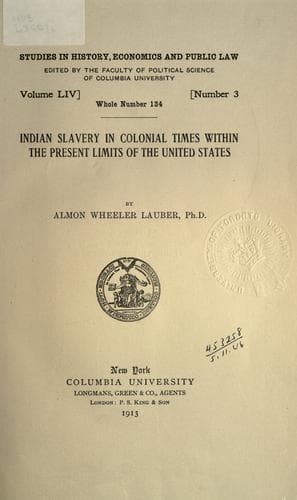
Indian slavery in colonial times within the present limits of the United StatesLauber, Almon Wheeler
History
Indian slavery in colonial times within the present limits of the United States
Lauber, Almon Wheeler
Indians of North America; Indians, Treatment of -- United States; Slavery -- United States; Thesis (Ph. D.)
[470] _Rhode Island Historical Society Collections_, v, p. 170; _Rhode
Island Historical Society Publications_, new series, i, p. 234. This
same town meeting freed certain Indians and gave them the rights of
inhabitants, and sentenced others to be shot for crime. _Early Records
of Providence_, viii, p. 12. These Indian captives were carried to
the port in a vessel belonging to Providence Williams, son of Roger
Williams. Staples, _op. cit._, p. 172.
[471] Roger Williams was a member of this committee.
[472] _Rhode Island Historical Society Publications_, i, pp. 236–238;
Arnold, _History of Rhode Island_, i, p. 425. For examples of
indentures or bills of sale, and receipts returned to the committee,
see _Early Records of the Town of Portsmouth_, pp. 430–433; vol.
01087 of the _Town Records of Providence_. See _Report of Record
Commissioners on Providence Town Records_.
[473] Richman, _Rhode Island, its Making and its Meaning_, ii, p. 192;
_Records of the Colony of Rhode Island and Providence Plantations in
New England_, ii, p. 549.
[474] Orcutt, _The History of the old Town of Derby, Connecticut_, p.
lvii.
[475] _Connecticut Colonial Records_, ii, p. 308.
[476] _William and Mary College Quarterly_, viii, p. 165.
[477] _Ibid._, viii, p. 165.
[478] Hening, _The Statutes at Large_, etc., ii, pp. 346, 404.
[479] Foote, _Sketches of Virginia, Historical and Biographical_, first
edition, p. 18.
[480] Hening, _op. cit._, ii, pp. 404, 440; _Virginia Magazine of
History_, ii, p. 173. This law is almost a literal transcript of
Bacon’s law.
[481] Ballagh, _A History of Slavery in Virginia_, in _Johns Hopkins
University Studies_, extra volume xxiv, pp. 35, 50; Hening, _op. cit._,
ii, pp. 346, 404.
[482] Hening, _op. cit._, iv, p. 10.
[483] _Ibid._, i, p. 259.
[484] _Ibid._, i, p. 459.
[485] Indians held in captivity before 1670 were not slaves but
servants. See Chapter ix.
[486] Before that time, the Indians had given little or no trouble, and
the colony had never passed a militia act.
[487] Every seventh man was to be pressed into service. William Fuller
was appointed to command.
[488] Allen, _A Calendar of Maryland State Papers_, i, p. 54. This
appears to have been the only attempt made by Maryland to enslave
Indian war captives.
[489] _North Carolina Colonial Records_, i, p. 900; ii, p. iv.
[490] _Ibid._, ii, p. 305.
[491] _Ibid._, ii, pp. iv, 52; Williamson, _History of North Carolina_,
i, p. 289.
[492] _North Carolina Colonial Records_, ii, p. 45.
[493] Rivers, _op. cit._, p. 132.
[494] Lands were also given as reward for valor, but they were not
acceptable for the people had no laborers to work them. Hewat, _op.
cit._, i, p. 78.
[495] Hewat, _op. cit._, i, p. 74.
[496] Blackstone, _Commentaries on the Laws of England_, Lewis edition,
1898, i, p. 108.
[497] _The Statutes at Large of South Carolina_, ii, pp. 189, 212.
[498] _Ibid._, ii, p. 212.
[499] In 1703, Sir Nathaniel Johnson succeeded Moore as governor.
Public-domain text, read in full here on John Shaqi.
Reviews
Reviews
No reviews yet
Be the first to share your thoughts on this work.
Elsewhere in the archive
Join the Discussion
Join the discussion
Sign in to leave a comment or review.
Sign InorCreate an account