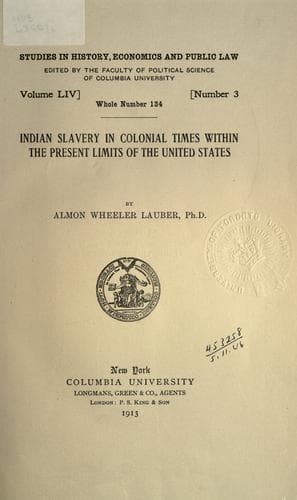
Indian slavery in colonial times within the present limits of the United StatesLauber, Almon Wheeler
History
Indian slavery in colonial times within the present limits of the United States
Lauber, Almon Wheeler
Indians of North America; Indians, Treatment of -- United States; Slavery -- United States; Thesis (Ph. D.)
[556] Shakespeare’s jeering remark in “The Tempest,” Act II, Scene II,
regarding those who refuse to help a lame beggar, but who will pay
their money to see a dead Indian, may apply to one of these captives.
Out of the common interest in savages the poet doubtless constructed
the monster, Caliban.
When the Plymouth colony was founded, two of these captives were
placed on board a vessel bound from Bristol to the coast of Maine. A
Spanish fleet captured the ship, and the Indians were carried to Spain.
Gorges afterward recovered one of these two, who, with at least two
others of the original five, was afterward sent to America. Gorges,
_A Briefe Narration of the Originall Undertakings of the Advancement
of Plantations into the parts of America_, etc., in _Massachusetts
Historical Society Collections_, series 3, vi, p. 54; Drake, _op.
cit._, edition of 1867, p. 13.
[557] Hubbard, _A General History of New England_, etc., in
_Massachusetts Historical Society Collections_, series 2, v, p. 37;
Drake, _op. cit._, edition of 1867, pp. 13–14. No record seems to exist
regarding the fate of these Indians. It may have been one of them
whom Gorges obtained from the Isle of Wight at the time the Earl of
Southampton was in command.
[558] Gorges, _A Briefe Narration of the Originall Undertakings of
the Advancement of Plantations into the parts of America_, etc., in
_Massachusetts Historical Society Collections_, series 3, vi, p. 59.
[559] Drake, _The Book of the Indians_, etc., ninth edition, bk.
ii, p. 8; Gorges, _op. cit._, in _Massachusetts Historical Society
Collections_, series 3, vi, p. 58; Bradford, _History of Plymouth
Plantation_, pp. 111–112, in _Original Narratives of Early American
History_.
[560] Gorges, _op. cit._, in _Massachusetts Historical Society
Collections_, series 3, vi, p. 60; Freeman, _Civilisation and
Barbarism_, etc., p. 39; Drake, _The Old Indian Chronicle_, edition of
1867, pp. 6–7.
[561] Smith, _A Description of New England_, etc., in _Massachusetts
Historical Society Collections_, series 3, vi, p. 132. There is no
reason to believe that Smith had ideas regarding the Indians different
from those held by the Englishmen of his time who did not rank the
savage above the position of the slave, and who generally looked upon
the Indians as a “degraded, inferior and faithless race, and no more to
be regarded than the Africans.” Drake, _op. cit._, edition of 1867, p.
7.
[562] O’Callaghan, _Calendar of Manuscripts_, etc., pt. ii, p. 117.
[563] Ellis and Morris, _King Philip’s War_, p. 294; Drake, _The Book
of the Indians_, etc., ninth edition, bk. iii, p. 104.
[564] Williamson, _The History of the State of Maine_, etc., i, p. 531;
Holmes, _American Annals_, etc., pp. 403–407; Hubbard, _A Narrative of
the Indian Wars in New England_, etc., pp. 332–344.
[565] _Records of the Court of Assistants of the Colony of
Massachusetts Bay_, i, p. 86.
[566] Futhey and Cope, _History of Chester County, Pennsylvania_, p. 39.
Public-domain text, read in full here on John Shaqi.
Reviews
Reviews
No reviews yet
Be the first to share your thoughts on this work.
Elsewhere in the archive
Join the Discussion
Join the discussion
Sign in to leave a comment or review.
Sign InorCreate an account