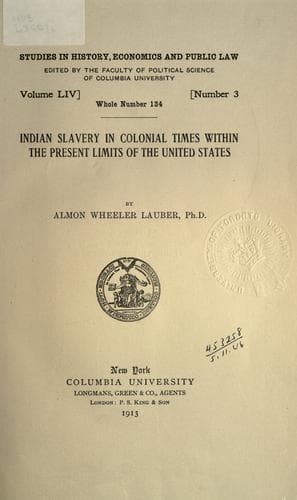
Indian slavery in colonial times within the present limits of the United StatesLauber, Almon Wheeler
History
Indian slavery in colonial times within the present limits of the United States
Lauber, Almon Wheeler
Indians of North America; Indians, Treatment of -- United States; Slavery -- United States; Thesis (Ph. D.)
During the intercolonial wars the French Indians were accustomed to
take both their white and red captives to Canada, where the latter
became slaves. As a part of their protective, diplomatic and military
policy, the English sought to regain the freedom of these Indians, and
thus retain the friendship of the Six Nations. In 1688, Governor Dongan
demanded of the French agents that certain New York Indians who had
been sent from Canada to France, be returned to the English consul at
Paris or to the authorities in London, so that they might be brought
home and be given their freedom. _New York Colonial Documents_, iii,
p. 526. The French authorities agreed, and the Indians were brought
back. _Ibid._, iii, pp. 621, 732, 733. In 1748, Governor Shirley sought
to obtain the freedom of a Rhode Island Indian who had been sold as a
slave in Canada, and on another occasion sent fourteen French prisoners
to South Carolina to redeem certain members of the Six Nations who
were held there. _Ibid._, vi, p. 448. Throughout the French and Indian
struggle the governors of New York insisted that the members of the
Six Nations, when captured in war, should be treated exactly as other
English subjects, or, in other words, that they should not be enslaved.
[547] _Hakluyt Society Publications_, vii, p. 23; Beazley, _John and
Sebastian Cabot_, p. 118.
[548] Beazley, _op. cit._, p. 118.
[549] Historians differ regarding the place where these Indians were
captured. J. G. Kohl, in _A History of the Discovery of the East Coast
of North America_, reprinted in _Maine Historical Society Collections_,
series 2, i, p. 142, expresses the opinion that Cabot probably obtained
them on some shore south of New York harbor. James S. Buckingham, in
_Canada, Nova Scotia_, etc., pp. 168, 337; and Samuel G. Drake, in _The
History and Antiquities of Boston_, i, p. 1, regard Newfoundland as the
probable home of the savages.
[550] Best, _Frobisher’s First Voyage_, in _Voyages of the Elizabethan
Seamen to America_, Payne’s edition, pp. 65, 66.
[551] _Ibid._, pp. 76–88.
[552] _Ibid._, p. 136.
[553] Mather, _Magnalia Christi Americana_, etc., first American
edition, (1820), i, p. 52; Prince, _A Chronological History of New
England in the Form of Annals_, edition of 1887, ii, p. 26; Rosier, _A
True Relation of the most prosperous Voyage made this present year_,
etc., in _Massachusetts Historical Society Collections_, series 3,
viii, p. 145.
[554] Gorges, _A True Relation of the late Battell fought in New
England_, etc., in _Massachusetts Historical Society Collections_,
series 3, vi, p. 51; Williamson, _The History of the State of Maine
from its first Discovery_, i, p. 207; Young, _Chronicles of the Pilgrim
Fathers of New England_, etc., second edition, p. 190.
[555] Stith, _History of Virginia_, bk. i, pp. 33, 34; Drake, _The Old
Indian Chronicle_, edition of 1867, pp. 10–13.
Public-domain text, read in full here on John Shaqi.
Reviews
Reviews
No reviews yet
Be the first to share your thoughts on this work.
Elsewhere in the archive
Join the Discussion
Join the discussion
Sign in to leave a comment or review.
Sign InorCreate an account