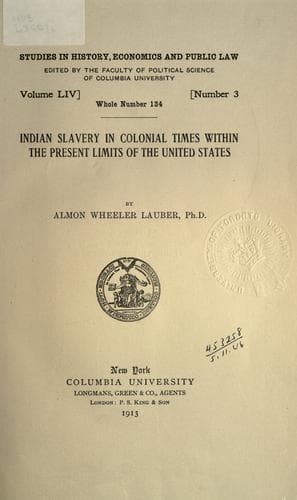
Indian slavery in colonial times within the present limits of the United StatesLauber, Almon Wheeler
History
Indian slavery in colonial times within the present limits of the United States
Lauber, Almon Wheeler
Indians of North America; Indians, Treatment of -- United States; Slavery -- United States; Thesis (Ph. D.)
[585] Vol. XXX, No. 227 A. of the Massachusetts manuscript records
contains a petition, dated September 20, 1676, of one John Harton
imprisoned for stealing Indians, asking freedom under bail in order to
support his wife and family.
[586] Felt, _The Ecclesiastical History of New England_, ii, p. 418.
[587] Leaming and Spicer, _The Grants, Concessions and Original
Constitutions of the Province of New Jersey_, etc., p. 105.
[588] _New Hampshire Historical Society Collections_, viii, p. 11.
[589] Hewat, _op. cit._, i, p. 126.
[590] Margry, _op. cit._, vi, p. 316.
[591] _Ibid._, v, pp. 178, 354, 360, 361; _Wisconsin Historical Society
Collections_, xvi, p. 332.
[592] _South Carolina Historical Society Collections_, v, pp. 166,
460–462; _Narratives of Early Carolina_ (Woodward’s relation of his
Westo voyage), p. 133, in _Original Narratives of Early American
History; Calendar of State Papers_, colonial series, vii, p. 634. One
of the instruments of supply was the Cherokee. Thomas, _The Indians of
North America_, etc., p. 96; Logan, _The History of Upper Carolina_, i,
p. 174.
[593] In 1666 Robert Sanford, secretary of the proprietors, made a
voyage from Cape Fear to Port Royal and reported to the proprietors
that the Indians of that section were anxious for friendship with the
whites “notwithstanding we ... had killed and sent away many of them.”
_Robert Sanford’s Relation of his Voyage in 1666_, in _Charleston Year
Book_, 1885, p. 292.
[594] Rivers, _A Sketch of the History of South Carolina_, etc.,
appendix, p. 353; _Journal of the Grand Council of South Carolina_,
August 25, 1671–June 24, 1680, p. 84.
[595] For the character of the Carolina settlers, see McCrady, _The
History of South Carolina under the Royal Government_, pp. 297–298.
[596] Rivers, _op. cit._, p. 126, holds that but little credit can be
given to the assertion that the colonists instigated the tribes against
each other for the purpose of trading in their captives. Hewat, _op.
cit._, i, pp. 126–127, asserts that the colonists early found out the
usefulness to this end of setting one tribe of Indians against another.
Lawson, _The History of Carolina_, etc., p. 325, tells of the Coranine
Indians inviting the Machapunga Indians to a feast, taking them
prisoners and selling them to the English.
[597] Rivers, _op. cit._, p. 126; Hewat, _op. cit._, i, p. 127.
[598] Hewat, _op. cit._, i, p. 127.
[599] French, _op. cit._, pt. iii, p. 36.
[600] _Public Records of South Carolina_, 1706–1710, p. 197; _B. P. R.
O._, vol. 620.
[601] Winsor, _The Mississippi Basin_, etc., p. 133. The English in
their turn accused the French of pillaging the traders.
[602] Margry, _op. cit._, iv, pp. 406, 507, 516.
Public-domain text, read in full here on John Shaqi.
Reviews
Reviews
No reviews yet
Be the first to share your thoughts on this work.
Elsewhere in the archive
Join the Discussion
Join the discussion
Sign in to leave a comment or review.
Sign InorCreate an account