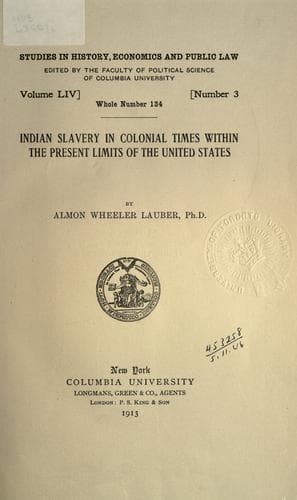
Indian slavery in colonial times within the present limits of the United StatesLauber, Almon Wheeler
History
Indian slavery in colonial times within the present limits of the United States
Lauber, Almon Wheeler
Indians of North America; Indians, Treatment of -- United States; Slavery -- United States; Thesis (Ph. D.)
[647] Hening, _op. cit._, i, p. 482; ii, pp. 143, 155; Lawson, _The
History of North Carolina_, p. 280.
[648] Margry, _op. cit._, iv, pp. lvi, 531, 544, 561.
[649] Hening, _op. cit._, i, p. 455.
[650] Hening, _op. cit._, ii, p. 143.
[651] _Ibid._, ii, p. 155; Tucker, _A Dissertation on Slavery_, p. 32.
[652] Hening, _op. cit._, ii, p. 283.
[653] _Ibid._, iii, p. 69.
[654] Lawson, _The History of North Carolina_, p. 280.
[655] _North Carolina Colonial Records_, ii, p. 252.
[656] A letter from the governor and council of South Carolina, May
7, 1707, states: “We have also commerce with Boston, Rhode Island,
Pennsylvania, New York and Virginia, to which places we export Indian
slaves.” _Bancroft Papers relating to Carolina_, in New York City
Public Library, MSS., vol. i, 1662–1769; Thomas, _The Indians of North
America_, etc., p. 95; Coffin, _A Sketch of the History of Newbury_, p.
336; _Journal of the Board of Trade, Public Record Office_, Co. 391,
25 R, xvii, p. 168. The colonial newspapers mention Carolina Indians
in the following issues: _Boston News Letter_, July 31, 1704: October
28, 1706; March 31, 1707; November 15, 1708; August 6, 1711; August 20,
1711; September 10, 1711; December 10, 1711; July 5, 1714; September
17, 1716; March 11, 1717; _New England Courant_, August 19, 1723.
[657] _Acts and Resolves_, i, p. 698. July 15, 1715, Mr. Bannister
of Virginia appeared before the Board of Trade and declared that the
selling in New England of Indian slaves taken in war had caused so much
injury by arousing the hostility of the neighboring natives, that the
legislature of Massachusetts had been obliged to pass a law prohibiting
the buying or selling of any Indians as slaves. _Journal of the Board
of Trade, Public Record Office_, Co. 391, p. 169.
[658] _Acts and Resolves_, ii, p. 364. The unforeseen exigencies were
“death, danger of the seas, captivity or inevitable accident.”
[659] Hoadly, _Records of the Colony or Jurisdiction of New Haven from
May, 1653, to the Union_, etc., p. 177.
[660] _Connecticut Colonial Records_, v, p. 516.
[661] _Connecticut Colonial Records_, v, pp. 534–535.
[662] _Acts and Laws of the State of Connecticut, in America_, edition
of 1784, p. 230.
[663] _Connecticut Colonial Records_, xiv, p. 329.
[664] _Records of the Colony of Rhode Island and Providence
Plantations_, ii, p. 550.
[665] _Ibid._, iii, p. 483.
[666] _Records of the Colony of Rhode Island and Providence
Plantations_, iv, pp. 193–194.
[667] _Laws of New Hampshire_, edition of 1771, p. 53; edition of 1726,
p. 49; _Magazine of American History_, xxi, 1889, p. 62.
[668] McClintock, _History of New Hampshire_, p. 151.
[669] _New York Colonial Documents_, xii, p. 414.
[670] _Pennsylvania Archives_, first series, xii, p. 280; _Bancroft
Papers relating to Carolina_, in New York City Public Library, MSS.,
vol. i, 1662–1769; Thomas, _The Indians of North America_, etc., p. 95.
Public-domain text, read in full here on John Shaqi.
Reviews
Reviews
No reviews yet
Be the first to share your thoughts on this work.
Elsewhere in the archive
Join the Discussion
Join the discussion
Sign in to leave a comment or review.
Sign InorCreate an account