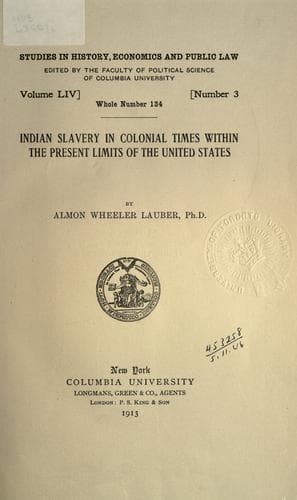
Indian slavery in colonial times within the present limits of the United StatesLauber, Almon Wheeler
History
Indian slavery in colonial times within the present limits of the United States
Lauber, Almon Wheeler
Indians of North America; Indians, Treatment of -- United States; Slavery -- United States; Thesis (Ph. D.)
[632] _Indian Book_, 1710–1718, i, p. 17, in Columbia, South Carolina,
Historical Commission Department. The letters of the missionaries
of the Society for the Propagation of the Gospel in Foreign Parts
stationed in South Carolina contain frequent mention of the traders’
action: Letters of Le Jau, 1708: February and July, 1711 (The letter of
February 20, 1711, relates an instance of the traders bringing back one
hundred Indian slaves); August 10, 1714; Letters of Johnston, January
27, 1715; December 19, 1715, in _Records of the S. P. G. F. P._
[633] _Indian Book_, 1710–1718, i, p. 29, in Columbia, South Carolina
Historical Commission Department, (directions given to traders, July
24, 1716).
[634] _Ibid._, i, p. 156, (directions given to traders, May 14, 1717);
i, p. 28, (directions given to traders July 24, 1716); i, p. 40,
(directions given to traders, July 27, 1716).
[635] Logan, _op. cit._, i, p. 180.
[636] Logan, _op. cit._, i, p. 187.
[637] On being handed over to the board, the Indians were ordered to
be sold at auction at a specified time and place to anyone who would
promise to export them from the province within a specified time. In
the meantime they were fed and sheltered at public expense. Logan, _op.
cit._, i, p. 156.
[638] Logan, _op. cit._, i, p. 171. Johnson became governor in 1703.
[639] _Ibid._, i, p. 182.
[640] Logan, _op. cit._, i, pp. 175, 177, 180, 181, 182, 183 cites
such trials. A letter of Steevens, missionary of the Society for the
Propagation of the Gospel in Foreign Parts, in South Carolina, 1708,
tells of the trial and acquittal of traders for the illegal enslavement
of Spanish Indians. _Records of S. P. G. F. P._
[641] Logan, _op. cit._, i, p. 180.
[642] _Ibid._, i, p. 182.
[643] _Ibid._, i, pp. 183–186. Case of Alexander Long and Eleazer
Wiggon who in revenge stirred up the Cherokee to destroy the Euchee.
[644] On July 15, 1715, Mr. Byrd, one of the council of Virginia,
appeared before the Board of Trade, and in reply to questions regarding
the hostilities lately committed by the Indians on Carolina, declared
the action of the Indians to be due to the cupidity of the traders and
the custom of encouraging the Indians to wage war on each other that
the traders might buy the captives as slaves. _Journal of the Board
of Trade, B. P. R. O._, Co. 391, 25 R., xvii, pp. 167–168. Similar
statements were made by Mr. Banister, _Ibid._, p. 169, Mr. Kettleby,
_Ibid._, p. 175 and Mr. Crawley, _Ibid._, p. 191.
[645] _South Carolina Public Records_, April to December, 1720, vii, p.
226; _British Public Record Office, South Carolina, Board of Trade_,
Co. 5, 358 A 14 and 15, October 27, 1720.
[646] Logan, _op. cit._, i, p. 189. Though no estimate of the number of
Indians enslaved during this long period in the south is possible, it
was so large that the decay of the coast Indians has been attributed to
it. Thomas, _The Indians of North America_, etc., ii, p. 95.
Public-domain text, read in full here on John Shaqi.
Reviews
Reviews
No reviews yet
Be the first to share your thoughts on this work.
Elsewhere in the archive
Join the Discussion
Join the discussion
Sign in to leave a comment or review.
Sign InorCreate an account