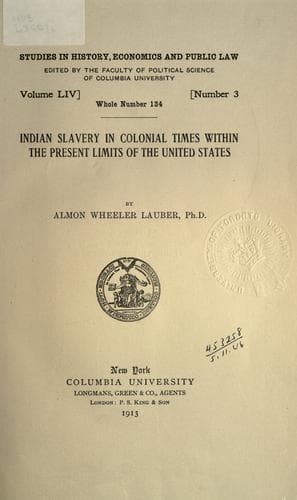
Indian slavery in colonial times within the present limits of the United StatesLauber, Almon Wheeler
History
Indian slavery in colonial times within the present limits of the United States
Lauber, Almon Wheeler
Indians of North America; Indians, Treatment of -- United States; Slavery -- United States; Thesis (Ph. D.)
[688] _Ibid._, ii, 364. Palfrey, _History of New England_, ii, p. 30,
points out that the expression in the Massachusetts Body of Liberties,
“willingly sell themselves,” related to such as contracted to labor
for a term of years, though in some cases, such term might have been
for life. The engagement, whatever its duration, would be subject to
transference to a third party, in which case the original contractor
would be “sold.”
[689] _Acts and Resolves_, iv, p. 641.
[690] Arnold, _History of Rhode Island and Providence Plantations_, ii,
p. 101; _Rhode Island Historical Society Collections_, vii, p. 232.
[691] _Early Records of the Town of Providence_, xvi, p. 244. Weeden,
_Early Rhode Island_, p. 173, mentions such slaves in 1750.
[692] _New York Colonial Documents_, v, p. 433.
[693] _Ibid._, vi, p. 546.
[694] _New York Colonial Documents_, vi, p. 546.
[695] List given in Ross, _History of Long Island_, i, p. 125.
[696] Rivers, _Topics in the History of South Carolina_, p. 51.
[697] _Ibid._, p. 51. It will be noted that in both the South Carolina
cases cited, the sentence of transportation and slavery was passed
before the Indians concerned were proved guilty of the charges against
them.
[698] Winthrop, _Journal_, Savage edition, i, p. 233 (editor’s note);
Hildreth, _A History of the United States from the Discovery of the
Continent_, etc., i, p. 239.
[699] Hening, _op. cit._, ii, p. 15.
[700] Hening, _op. cit._, iv, p. 104; _Historical Documents from the
Old Dominion_, No. 3, p. 258. The governor and council, without a jury,
were to act as a court for the trial of such offenders.
[701] Shurtleff, _Records of the Governor and Company of the
Massachusetts Bay in New England_, i, p. 329.
[702] Freeman, _The History of Cape Cod_, ii, p. 72; Thacher, _History
of the Town of Plymouth_, p. 149.
[703] _Calendar of State Papers_, colonial series, ix, p. 307; Cook,
_Drummond Island_, p. 70. To retain their services for a time longer
than that specified in the sentence of the court, the whites were
accustomed on the ninth day to furnish the Indians with rum and get
them drunk so that they must remain ten days longer. The practice
was so long continued that at one time there was several hundreds
of Indians on the island, “many whereof had been by the practices
aforesaid kept about three months.”
[704] _Plymouth Colony Records_, vi, p. 104.
[705] _Manuscript Council Records of Massachusetts_, ii, p. 40; _Laws
of New Hampshire, Provincial Period_, i, p. 116.
[706] _Manuscript Council Records of Massachusetts_, ii, p. 310.
[707] Freeman, _The History of Cape Cod_, i, p. 714.
[708] _Sewall’s Diary_, in _Massachusetts Historical Society
Collections_, series 5, vi, p. 143.
[709] _Manuscript Council Records of Massachusetts_, viii, No. 169.
[710] _Ibid._, ccxxxii, No. 1.
Public-domain text, read in full here on John Shaqi.
Reviews
Reviews
No reviews yet
Be the first to share your thoughts on this work.
Elsewhere in the archive
Join the Discussion
Join the discussion
Sign in to leave a comment or review.
Sign InorCreate an account