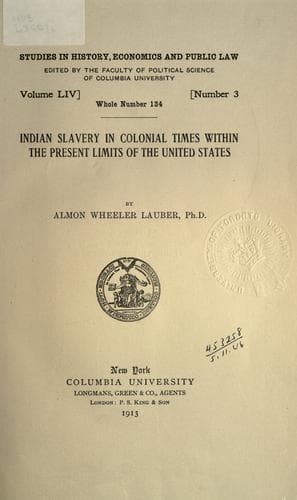
Indian slavery in colonial times within the present limits of the United StatesLauber, Almon Wheeler
History
Indian slavery in colonial times within the present limits of the United States
Lauber, Almon Wheeler
Indians of North America; Indians, Treatment of -- United States; Slavery -- United States; Thesis (Ph. D.)
[711] _Boston Public Library Monthly Bulletin_, vii, February, 1902,
p. 74. This Indian was stolen from his owner by pirates and carried to
South Carolina, but escaped and returned to New England. He was about
to return to his master to serve out his term of servitude when he was
seized by two white men of Massachusetts and enslaved by them.
[712] _Manuscript Council Records of Massachusetts_, xxxi, No. 148.
[713] _Acts and Resolves_, xii, p. 602.
[714] Arnold, _History of the State of Rhode Island and Providence
Plantations_, i, p. 271.
[715] Durfee, _Gleanings from the Judicial History of Rhode Island_, p.
131, in _Rhode Island Historical Tracts_, No. 18.
[716] Arnold, _op. cit._, i, p. 423.
[717] The code provided that, in case an Indian should fail to give the
satisfaction required in case of conviction, the court might sentence
him to serve the injured party as a slave, or to be shipped out of the
country in exchange for negroes. _Connecticut Colonial Records_, i, p.
532.
[718] Hildreth, _The History of the United States_, i, p. 372.
[719] Orcutt, _The History of the old Town of Derby, Connecticut_, p.
lvii.
[720] _Plymouth Colony Records_, ix, p. 71; _Connecticut Colonial
Records_, i, p. 532.
[721] Moore’s article in _Historical Magazine_, x, p. 189.
[722] _The Statutes at Large of South Carolina_, vii, p. 352.
[723] _Ibid._, vii, p. 371.
[724] _The Statutes at Large of South Carolina_, vii, p. 385.
[725] _Ibid._, vii, p. 397. The act decreed that “all negroes and
Indians (free Indians in amity with this government, and negroes,
mulattoes, mustizoes, who are now free, excepted), mulattoes or
mustizoes who now are or shall hereafter be, in this Province, and all
their issue and offspring, born or to be born, shall be, and they are
hereby declared to be, and remain forever hereafter, absolute slaves
and shall follow the condition of the mother.”
[726] Hening, _op. cit._, iii, p. 460.
[727] _Ibid._, iv, p. 133.
[728] Stroud, _A Sketch of the Laws relating to Slavery_, etc., p. 2.
[729] _Ibid._
[730] _Archives of Maryland_, xiii, p. 546.
[731] Maxcy, _The Laws of Maryland_, etc., i, p. 115; Bacon, _Laws of
Maryland_.
[732] _Colonial Laws of New York_, edition of 1894, i, p. 598; Trott,
_Laws of the British Plantations in America_, etc., p. 273.
Public-domain text, read in full here on John Shaqi.
Reviews
Reviews
No reviews yet
Be the first to share your thoughts on this work.
Elsewhere in the archive
Join the Discussion
Join the discussion
Sign in to leave a comment or review.
Sign InorCreate an account